Showing posts with label Boat Inn. Show all posts

Monday, 8 November 2021

192. English Peasant Food?


  Fine dining is all very well but sometimes you just need a good scoff served well in an interesting and pleasing location. A good scoff might be defined as good English peasant food, comforting and delicious, as opposed to French peasant food which is much poorer quality than foodies care to admit. Of course real peasants in olden days would not have scoffed great slices of grand roast beef and a plate weighed down with an array of vegetables but English peasant food probably dates from the Fifties onwards, after the austerity of the Second World War and Attlee’s post-war Labour government whose obsession with rationing virtually starved the working people which Labour claimed to represent. Thus the post-rationing generation, celebrating their release from the threat of fascism and the austerity of socialism, learned to eat good food again and in sensible quantities so that they were slim and healthy as the 1950s drew to a close but enjoying good meat, good fish and a cornucopia of vegetables.

  Then Elizabeth David came along and told them all that their food was disgusting and that the French and the Italians dined much better. And the middle classes believed her and modern English food history began. 

  But the English did not give up without a fight and so the Sunday roast held on and it became an English icon. Of course those who knew no better and guided by the vast greed coming in from across the Atlantic where bulky people consumed gargantuan portions at every meal started to feel it necessary to serve Yorkshire pudding with everything and not just roast beef and some establishments added stuffing and inappropriate sauces to all meats. The urban peasant food of the 1950s became fine-tuned to a vast plate of beef or pork or turkey with all the trimmings and mounds of the more popular vegetables. So am I complaining? To be fair, my gastrointestinal system knows when to warn me that I’m overdoing consumption but sometimes it’s pretty good fun to just let rip and go for it.

  And so Lucy The Labrador and I were back in Birmingham’s seaside resort - Weston super Mare - and I had made reservations for two meals - a dinner and, of course, Sunday lunch at the Ginger Pig Kitchen again (see Blog 186). This was not fine dining - it was just happy eating.

  Under the gaze of the faux Damien Hirst-style pig’s head mounted on the wall scrutinising the visitors to its bistro I was made welcome and seated comfortably and presented, as before, with an amuse gueule in the form of a spoonful of clever melon gazpacho - give us a bowlful of it please for God’s sake, I don’t care if winter is close upon us, and then served with cauliflower and onion barjis with an alluring-sounding mango yoghurt. Sadly the bharjis were heavily over fried - the taste of burnt bharji is not a happy one but putting them behind me I moved on to a dish which seemed to have its day for a longtime now - from hero to zero in recent years - but which is absolutely ideal for a restaurant such as the Ginger Pig - an excellent confit Duck’s leg, moist, tasty, a lesson that even the French ate pleasurable peasant dishes at one time or the other accompanied by sweetly pleasing garlicky potato gratin and perfectly cooked green beans and a deliciously unctionious sauce. Great scoff indeed. All rounded off by a fine vanilla crème caramel served with a perfectly crispy thin biscuit in the delightful shape of what else but a pig.


 Back for Sunday lunch and straight to the main course. Having felt it necessary to acknowledge the pig on the wall by having roast pork the last time I had Sunday lunch there I felt free, even obliged, to choose the roast beef of England on my latest visit. I was not disappointed - it came served as a large and rather grand thick slice lying relaxed and tender over its bed of three well-cooked roast potatoes and cosily covered by a duvet of spot-on Yorkshire pudding with a fun bedside table of crispy deep-fried kale and a little moat of gravy. Along came the vegetables - a sweet and tender carrot, cauliflower with a cheese sauce made by someone who knows what they are doing and a generous supply of red cabbage and broccoli. How pleasing it is to be a 21st century English peasant.

  Casting aside the guise of English peasant I opted to combine my dessert with my coffee and chose to finish off with affogato. Well Elizabeth David had to serve some purpose in bringing the Mediterranean to this sceptred isle.


Michelin Guide Twitter watch:- Here are the latest West Midlands restaurants about which a Michelin inspector has tweeted. The first, notably, is in Shropshire (a county much loved by the inspectors in comparison with some of the West Midlands counties and only slightly less visited than the Cotswolds) - 

27 October - The Haughmond, Upton Magna, currently a Michelin Plate holder.


1 November - Opheem, currently a holder of 1 Michelin star.


6 November - The Boat Inn, Lichfield, currently a Michelin plate holder.


  On the subject of inspectors and food critics there is a very amusing cameo by Adrian Edmondson in the 6th episode of the first series of the BBC’s riotous comedy, Absolutely Fabulous (1992), one of the few very funny programmes it has ever made at a time when offending someone was not considered a crime against humanity. In it Edmondson plays a restaurant critic on the magazine for which Patsy, Joanna Lumley, is ‘Fashion director’ and though his ‘hour upon the stage’ is no more than a matter of seconds it is a very funny lampoon of these critics and it must have had chefs of the time rolling in the aisles if they ever had time to sit down and watch television.

Magda: “Hamish, tell me about this restaurant I’m having lunch at”.

Hamish: “Hmm. Comfortable. In a grand manner. Stuffed with plutocratic goodies and a decent duck. A dining room boudoiresque fin de siècle collection but still fashionably uncomfortable. A mélange. Possibly a post-Orwellian version of an Edwardian eatery. The food ecumenical in flavour; a cosmopolitan adventure of exuberant eclecticism full of amuse gueule and gastrocredibility. Low flashes of bain-marie dish. A tomato rather pulpeuse.

Magda: “Ta”


  More on the BBC and dining out. With the next season of Masterchef The Professionals now beginning, advance publicity identifies that Yasmine Selwood from Wednesbury who was a commis chef at Adam’s from 1920-21 will be one of the featured contestants. She studied at University College Birmingham from 2017 to 2021 and it was during the period of her studies that she worked at Adam’s. She now works as a private chef.


  However appearing as the first contestant in the first heat of this new season (screened 8 November) was another Brummie chef, Dan Lee, who also works as a private chef. He was the first to face Marcus Waring’s surprising ‘Skills challenge’ which involved preparing bangers and mash with a rich honeyed onion gravy. At this he was largely successful despite his sausages rupturing during the cooking - which of us hasn’t ruptured our sausages at some time or the other? - and he emerged from the first round as clear winner which was confirmed by the outstanding success of his two course meal in which he served up a beautiful-looking plate of marinated monkfish tail with a tamari and curry sauce, charred okra, Thai aubergines, coriander and crispy shallots. Waring waxed lyrical about the dish describing it as “absolutely delicious”, “texturally beautiful” and “a cracking dish”.

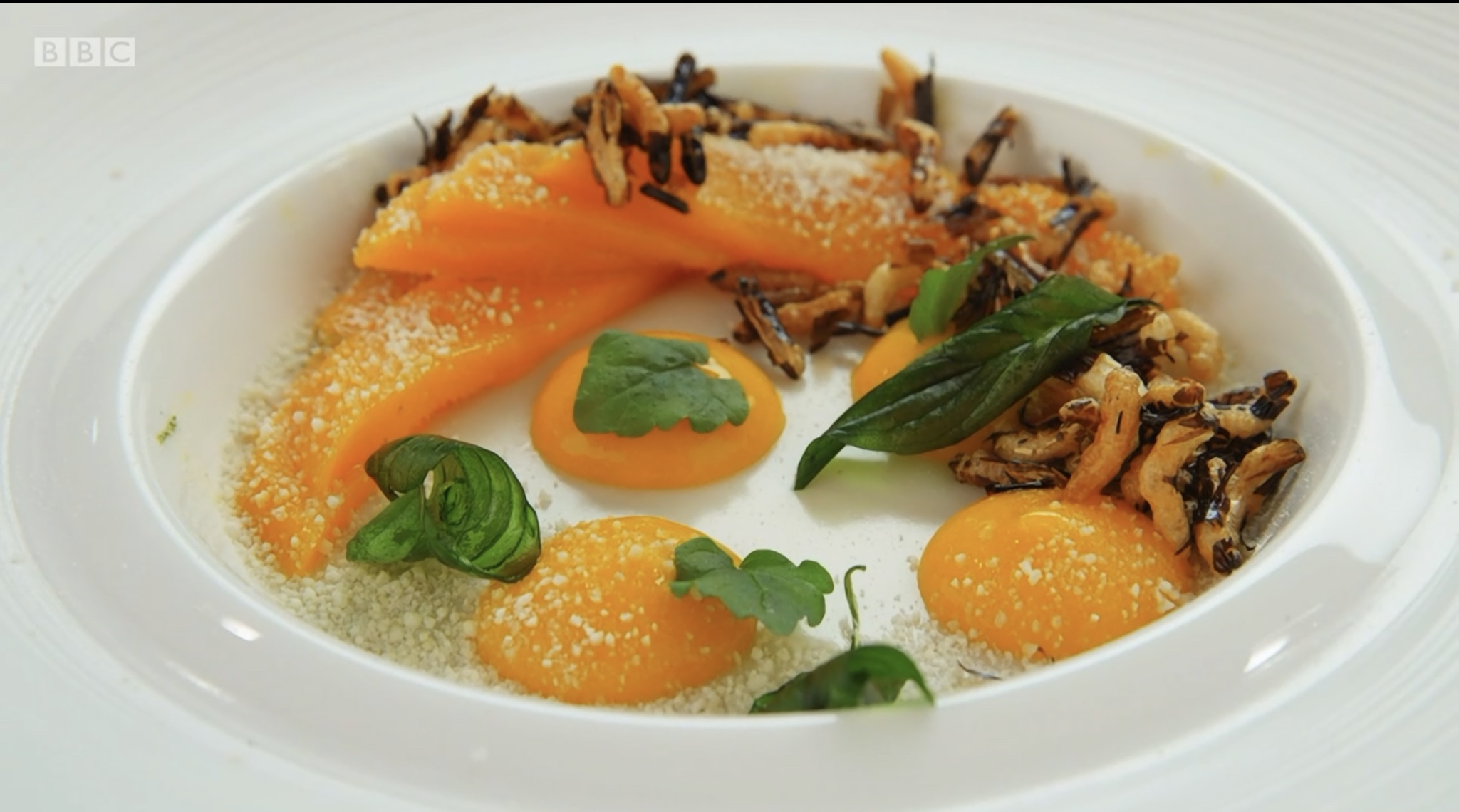
   The dessert was no less successful being, as the narrator Sean Pertwee described it, “a take on mango sticky rice” made up of a coconut and Thai basil panna cotta topped by compressed mango with lime and mango gel, puffed rice and toasted rice powder.

  Lee was the undisputed winner of the heat and it will be fascinating to see what dishes he delivers in upcoming episodes.


Thursday, 25 March 2021

136. Central Region Starts Off 2021 Great British Menu.


At last some good sense seems to have entered into the brains of the BBC’s Great British Menu (GBM) production team. The series which recommenced last night was fronted by the very sensible and informed Andi Oliver instead of a silly comedienne who caused persistent irritation thoughout the last series and the new series also benefitted from starting off with the Central region heats even though 2 of the chefs did not work in either the Midlands or East Anglia as well having Lisa Goodwin Allen as guest chef-judge twinned with Simon Rogan for the fish course because of her shellfish allergy. The theme of this year’s series is British innovators.


  The four competing chefs were detailed in Blog 133 and I have to admit that I was backing the two chefs who are working here in the West Midlands rather than those who were based in London. It always looked as though London-based Shannon Johnson was doomed to be the first chef to be eliminated from the competition with her amuse bouche being judged to be rather less satisfactory than the others and by the end of the programme she was on her way out. The future doesn’t look too promising for London-based Sabrina Gidda either though the judges often seem to have an unspoken rule that any chef having a third attempt to reach the regional finals will not be humiliated by being booted out without an opportunity to lay their fayre before Waldorf and Statler and whichever female is occupying the third judge’s chair this particular series. We shall see.


At this stage it looks very much as though Stuart Collins of Docket No. 33 in Whitchurch in Shropshire has his place booked in the regional final and I hope that Liam Dillon - good to hear someone speaking with a fine Staffordshire accent - from the The Boat Inn in Lichfield will be joining him. For his starter Collins prepared a dish which commemorated Elsie Widdowson who worked on providing a nutritious diet on the ingredients available in wartime Britain, the dish being named Take it with a grain of salt - pork cheek, smoked bacon, fresh apple, roasted apple purée, pickled apple served on a bed of choucroute (sauerkraut, fermented cabbage) with pork airbag (crispy dehydrated pork skin - posh scratchings which served as the “grain of salt”. The dish was well-received and scored 8. For his fish course Collins prepared a dish called Singularity which commemorated Stephen Hawkins’ theory of blackholes and this was made up of beetroot and fennel-cured trout served on taramasalata with golden and candy beetroot with nasturtium leaves and 2 types of caviar under a black coral tuile. A wonderful looking dish and singularly successful being awarded 9 points. Collins was well in the lead.


  Liam Dillon’s creations were a starter named Flick the kettle on which commemorated the unsung Birmingham hero, Arthur L Large, who developed the element in electric kettles which revolutionised how we make a cup of tea or coffee. The dish was made up of beef sirloin and onion broth, bone marrow and bread and butter pudding with a sharp herby emulsion of various salad vegetables with garden vegetables to give it added texture. The broth was served, appropriately, in a kettle. The starter tied with Collins’ 8 points. Dillon’s fish course, The Apple (celebrating Isaac Newton’s discovery of gravity) was served up in a hollowed out apple and made up of whole Dorset crab with the brown meat used for an emulsion, a dashi made from kelp, tuna flakes, soy and mirin, lingonberries and pickled elderberries served with lavosh crackers hung from miniature apple trees. A visually remarkable dish but awarded only 7 points.


  True enough, at the end of the programme Johnson was eliminated and the main course and dessert lay ahead for the next programme. Stuart Collins was 2 points ahead but, as they say, there was still everything to play for.


Thursday, 11 March 2021

133. Great British Menu 2021.


 The BBC series, Great British Menu, which, though I frequently moan about it, is unmissable for me returns to television screens on 24 March 2021. As we might expect from previous experience, the Central region (the great swathe of the West and East Midlands plus East Anglia) is poorly represented both by the number of competing chefs chosen to appear in the series and by the Central region’s restaurants showcased. Thus the chefs of only two West Midlands restaurants are to appear in the series while the other two featured in the Central heats actually work in London restaurants. I suppose the West Midlands has done well to have two of its restaurants highlighted given that BBC luvvies seem so unwilling to make programmes here (even Peaky Blinders is made improbably in Manchester which must be a pain to the dears who work for the BBC given that the city is, certainly to extrapolate from its Michelin star ratings, a virtual gastronomic desert).


  The competing chefs in the Central region heats will be Sabrina Gidda, who qualifies by having been brought up in Wolverhampton but who actually works at The AllBright in London (this will be her third attempt), Shannon Johnson who was brought up in Lincolnshire but who also works in London at Hicce, Stuart Collins who opened Docket No. 33 in Whitchurch in Shropshire in 2017 where he is Chef Patron and Liam Dillon from Lichfield where he has been chef owner of the Boat Inn since 2017.

  Meanwhile the series returns largely unchanged except that it has ditched the irritating comedienne, Susan Calman, as presenter, a role which Andi Oliver takes over after making a fair fist of doing the job in the 2020 Christmas series. Meanwhile Rachel Khoo replaces Andi Oliver as the third judge while Waldorf and Statler otherwise known as Matthew Fort and Oliver Peyton continue their pleasingly eternal roles as judges dating back to time immemorial. Wikipedia describes Khoo as “a British cook, writer and broadcaster, with her own BBC and Food Network television cooking series”. So that’s alright then.

  The theme of this year’s series will be ‘British innovation’ and commemorates the 30th anniversary of Sir Tim Berners-Lee’s making the worldwide web available to the general public. Pre-programme publicity predicts that we will see more than our fair share of all that is grim in modern gastronomy - numerous instances of molecular gastronomy and more than enough dishes cooked sous vide. Our Lichfield chef, Liam Dillon is said to be preparing a dish recalling Dr Johnson, a resident of the city and father of the English dictionary, so one hopes than Dr Johnson will not be forced whist sitting at his dining table in Paradise to express to his companion, Mr Boswell, an honest opinion after being served a dish cooked sous vide, which after all isn’t even English and really should have by now been fully parked up (with wheels clamped) the gastronomic cul de sac it represents.

  Still, the theme of innovation is an interesting one and so let us hope that the dishes which pop up in the 8 weeks of programmes point to a sane and interesting future for our restaurants.

The Boat Inn - 


Docket No. 33 - 


Tuesday, 11 September 2018

33. Ludlow Food Festival 2018.


  The dog and I passed a happy weekend in Ludlow attending the country's oldest food festival for our fourth consecutive year.
 Just ahead of this the Good Food Guide 2019 had added three new local restaurants to its listing - Forelles located in Fishmore Hall where the dog and I were staying for the festival as we always do, Mortimer's and Old Downtown Lodge - meaning that 3 of the 7 newly-added restaurants in the West Midlands are located in this, the original, food town - Ludlow returning to its sacred old place in English gastronomy we hope.


  The Festival as ever was enjoyable and the dog was in raptures about having her own ticket for the Sausage Trail. She and I were of one mind that this year AH Griffith's peppery and spicy sausage was the clear winner but we felt we could not complain about any of the five entrants in the competition. I had to buy myself some souvenirs to take home from the event and picked up a bottle of the excellent rhubarb Gun Dog Gin made by a family business in Herefordshire and a couple of bottles of wine from the Halfpenny Green vineyards in south Staffordshire - the dreamy Late Harvest 2014 made from Huxelrebe and Bacchus grapes and a bottle of the immensely tasty Mercia made from Madeleine Angevine and Ortega grapes. I also allowed myself the pleasure of buying some packs of Droitwich salt, extracted from Roman times from brine springs in this historic Worcestershire town. The West Midlands - we've got it all!


  There were some highly interesting presentations from chefs usually with, at some stage in their careers, a connection with Ludlow. The chefs were generally young but accomplished and many talked as much about the science of gastronomy as about the art of being a chef. That I thought, is the theme for now - the science of cooking.
  The theme cropped up frequently during the talk by chef David Kelman of Cowley Manor in Cheltenham and in the following demonstration by chef Joe Gould of Forelles whose food I was to eat later that day.


  So how did the science and the modern technology fare when I dined at Fishmore Hall that evening? It all started off with a delectable amuse bouche which was basically an elegant miniature kedgeree. A starter of quail made lively with goats curd and chorizo was very good but the main course of turbot was not as tasty as it promised to be. The dish included a crab gnocchi which I couldn't identify and an accompanying strip of chicken wing was very tasty but the texture was remarkably unpleasant resembling soggy cardboard. The highlight of the dish was a stupendous and unctuous chicken sauce which allowed one to forgive almost anything (apart perhaps from the texture of the chicken wing). Chef's dessert of banana parfait with white chocolate and pineapple restored pleasure to the meal and the coffee was accompanied by some interesting petit fours.


  On Saturday, Lucy The Labrador and I had a busy day at the Festival. I started off the day having coffee with a view (the beautiful Dunham Weir) at CSons Ludlow, formerly the Michelin Bib Gourmand-awarded Green Cafe. Inside the castle I listened to Liam Dillon talking about his restaurant in Lichfield and I was impressed by what he had to say so that I feel I must soon pay a visit to The Boat Inn. It's good to have an extra reason to visit another one of our beautiful West Midlands medieval towns. I missed a number of talks which I would have liked to visit because of the canine necessity of walking around the Sausage Trail!
  A second night of gastronomy at Forelles. After another joyous dip into the immaculate mini-kedgeree amuse bouche it was on to a starter of tasty sea trout accompanied by what seemed to be deep fried Serrano ham and beetroot, neither of which really worked for me (the texture of the Serrano was far from crispy and the beetroot, though it should be a perfect companion for oily fish, seemed to be too sweet to enjoy the trout to its best). The main course however was much more enjoyable than that of the previous evening - chicken cooked in hay with another gorgeous sauce, perfectly cooked asparagus and an oyster bonbon which was not entirely successful. For the second evening the dessert was highly enjoyable and memorable - a charming and delightful 'baked alaska' with peach.


  Lucy and I passed Sunday morning at the Festival. I enjoyed listening to a talk by Reuben Crouch who with his three brothers had opened CSons in Shrewsbury and had recently taken over the Green Cafe in Ludlow. I really must head for Shrewsbury in the foreseeable future. 
  So, another highly enjoyable and interesting weekend for man and dog in Ludlow. I've already booked my accommodation for next year's festival. Regardless of what south-east and London-based critics and food guide writers might think the West Midlands is a gastronomic region of which to be proud.