Showing posts with label Gin. Show all posts

Sunday, 10 October 2021

186. Pig Saves Brummies’ Favourite Seaside Resort.


 Whether or not the extended period of necessarily taking holidays in our precious islands has saved the English seaside resort from a progressive, seemingly terminal decline one cannot say but Weston super Mare has not had a bad summer season and on an early October Saturday, warmer and sunnier than we should expect, there are good numbers of people, from young families who look more middle class than they used to (day trippers from increasingly gentrified Bristol?, I ask myself) to those of advanced and even greatly advanced age (some dressed rather pensioner chic), walking up and down the Royal Parade, throwing balls for their numerous dogs on the vast expanse of beach and queueing for ice creams at the former Cove West cafe not far from the new pier. 

  In Blog 27 I referred to this North Somerset town’s importance to West Midlanders as a holiday resort for the working class in the historic past - in the 50s and 60s the dominant accent was more Brummie than West Country in the summer months as ten of thousands from the centre of England thronged the town, snuffling out the best fish and chips, the hottest hot dogs, plentiful pots of tea and buckets of ice cream (then just vanilla, strawberry, chocolate or perhaps raspberry ripple) like truffle pigs out on a mission. Now the Mercians as still coming to visit but there are just as many Home Counties accents to be heard, as well as those identifying the speakers as coming from The North and of course, there’s plenty of Welsh, from just round the corner across the bay.

  For years there was a remarkably good restaurant with marvellous views - Michelin-listed The Cove (see Blog 27) - but this sadly went the way of all flesh and for a short brief period, as Weston College extended its hegemony over most of the buildings in the town, there was Lasseter’s (again see Blog 27) but its promise was short-lived. Then COVID-19 struck, locks went down and up and down and up and down and up again, Brexit got done and sent the hospitality business into a staffing crisis, fuel costs began to soar (and the story is not yet told by a long chalk) and anyone trying to run a restaurant at present has to rely on Boris Johnson’s rule by optimism as the only assurance that their business can survive.

  So it was not good timing to open a restaurant in November 2019 just as the coronavirus was festering nicely up to a boil in far off Wuhan and Boris was putting his Brexit legislation through the House Of Commons. I hate the phrase “A perfect storm” but this was indeed a perfect storm. But not knowing all that - which of us did? - two chefs from Lasseter’s - David Newman and James Baker opened their first restaurant on the site of a former bistro at the edge of the town centre, the Weston Mercury at the time saying that “the kitchen offers traditional bistro food with a twist, ‘to make it a little bit more special’”.

  The bistro, which pleasingly does not include the word ‘bistro’ in its name instead choosing the uncompromisingly English Ginger Pig Kitchen, is splendidly rustic, adorned as it is with an artificial (hopefully), mildly unsettling  pig’s head mounted on the wall (a thought of ancient baronial halls their walls lined with mounted stags’ heads flashes irrelevantly through my mind) and heavily varnished wooden tables and a mélange of chairs. The place is full of diners which can not be bad for off-season Weston and there is a degree of Pensioner Chic in evidence.

  A surprise amuse bouche is whisked to the table. A soupçon of what was basically a melon gazpacho, mildly acidic and wholly effective in waking up the taste buds of refreshment. The problem with one amuse bouche is that you can not help but think that there should be another one or even another two. But still, a nice little surprise.

  Down to the serious stuff. An excellent chicken liver parfait with some very edible toasted brioche, a delicious apricot chutney and a sensible two or three cornichons to cut through the richness of the dish. Look at Blog 27 and it becomes apparent that the chefs have brought some of their Lasseter’s’ dishes with them.


Then magnificent and bountiful dressed Cornish crab served attractively in a scallop shell with a perfect accompanying lemon mayonnaise and toasted pain de campagne and a salad whose elements were not all complementary to the crab. There were a few tiny pieces of shell in the crab but they did not detract from the immense pleasure the dish gave me and to be fair, I have still to visit a restaurant that has succeeded n eliminating every vestige of shell from its dressed crab. Finally a dessert/drink I recognised from my visits to Lasseter’s - a vey quaffable affogato with local clotted cream ice cream and generously-sized chunks of honeycomb.

  A fine meal, outwardly simple but highly enjoyable with the crab dish well worth storing up in one’s memory as an example of just how good bistro food can be in the hands of the right chef.


  So good was it all that I returned the next day for Sunday lunch. Thus it was that I came face to face with Thatcher’s Gin not surprisingly endowed with the flavour of apple and very pleasant it was with good tonic and well matched with the prawn cocktail I chose as starter (again see Blog 27) which was a cornucopia of crustaceans, large and small, with a pleasing, mild, not too acidic Marie Rose sauce, all looking very pretty in a scallop shell.


 It was not possible for me to resist choosing the roast as main course; I could have had beef but why would you go to a restaurant called The Ginger Pig Kitchen and not choose pork? The succulent sliced pork came with about every Sunday lunch accompaniment that you could imagine and another cornucopia - this time of vegetables. There was a well cooked donkey carrot of a size I have previously seen served as the main element of a main course in an expensive Vegan restaurant, excellent cheesy cauliflower, broccoli and a happy surprise in the form of crispy cabbage as well as tasty red cabbage. The roast potatoes were better than many restaurants manage to serve up and there was a decent stuffing and a fine Yorkshire pudding plus apple sauce and crackling though this was sadly inedibly too hard unless one was ready to imperil the structure of one’s teeth. It was all finished off by a decent gravy. Such pleasure for we rostbifs or should I say rostporcs

  Having rediscovered the pleasure of affogato I rounded off the meal with that little self-indulgence. Chef David Newman came out to speak to his happy diners - once more the restaurant was full to the rafters with customers. It looks as though this restaurant is one little piggy that is not going to be slaughtered ahead of its time.









Monday, 13 September 2021

178. Ludlow Food Festival 2021.


 After a necessary year’s break (though there was an online version in 2020) the Ludlow Food Festival, Britain’s first, has returned to Ludlow Castle as autumn arrives in a timely way. Lucy The Labrador and I were in town for when the Festival opened its gates and I was surprised to see how many people were waiting to be admitted. 

 I attended all the talks from West Midlands chefs on the stage during the first day and broke them up by exercising the dog and visiting the fast food and other stalls. It was hard to believe that anyone was taking the pandemic seriously, no-one at all was wearing a mask, social distancing was a forgotten concept and the only visitors forced to keep their distance from the food tents were the multitude of dogs who, when you think about it, were probably a far lesser threat to the health of the humans than other humans. 

 The first speaker of the opening day was Reuben Crouch of C-Sons on The Green and C-Sons of Shrewsbury. He had been a speaker at the 2019 Festival and well worth listening to and he was the first speaker of the day to reflect on the difficulties of the pandemic and the possibly even greater difficulties now experienced by the hospitality industry due to the shortage of staff and the difficulties associated with supply problems.


  Well worth listening to was the Suffolk Food writer and Fisheries journalist, Mike Warner, who talked about preparing the various ingredients for a fruits de mer dish. The interviewer admitted she had never eaten an oyster so far in her life and was therefore encouraged by the audience, like a Collisium crowd gesturing a ‘thumbs down’ sign, to sample one, a fresh raw specimen. Warner advised that the best way to achieve most pleasure from the shellfish was to chew it and relish it slowly - first the salty, maritime “flavour of the ocean” followed by a sweetness and ending with a metallic burst. The interviewer was game though reluctant and with a moderate amount of gurning set about her task hardly with relish. She indicated that this might not only be her first oyster but also her last. 

  And then an enjoyable cooking demonstration by Andy Link, chef at the Riverside Inn in Aymestrey in Herefordshire. He had first spoken at the event about, I think 15 years ago as a mere lad, and now gave an account of his career and work in a fine restaurant in a Marches village and how he had dealt with the unique problems of the last 18 months.


  The final demonstration of the day on the Wardington’s original stage was by Mike Bullard, founder of the Butcher’s Social Club, now located in Dorridge. Bullard was asked about the evolution of his restaurant from a ‘pop-up’ in a butcher’s shop in Harborne, the several months of carrying on serving burgers and beer from there till he established himself in Henley in Arden. He found his restaurant was popular in the village but there was not sufficient passing trade and so he has recently moved on to the Forest Hotel in which The Butcher’s Social Club is now situated which offers greater opportunity for catering for events. He talked about how much of the restaurant’s meat is cooked in water baths (good for beef and lamb apparently, less so for pork) which greatly eases their preparation of large amounts of food. Well, each chef must choose what is best for his business but sous vide cooking may make good business sense but it often results in a less than satisfactory outcome for the diner - not so much Chef as artist as Chef as Swimming pool lifeguard. My enthusiasm for visiting the Butcher’s Social Club was considerably reduced by the prospect of everything there being largely cooked sous vide.


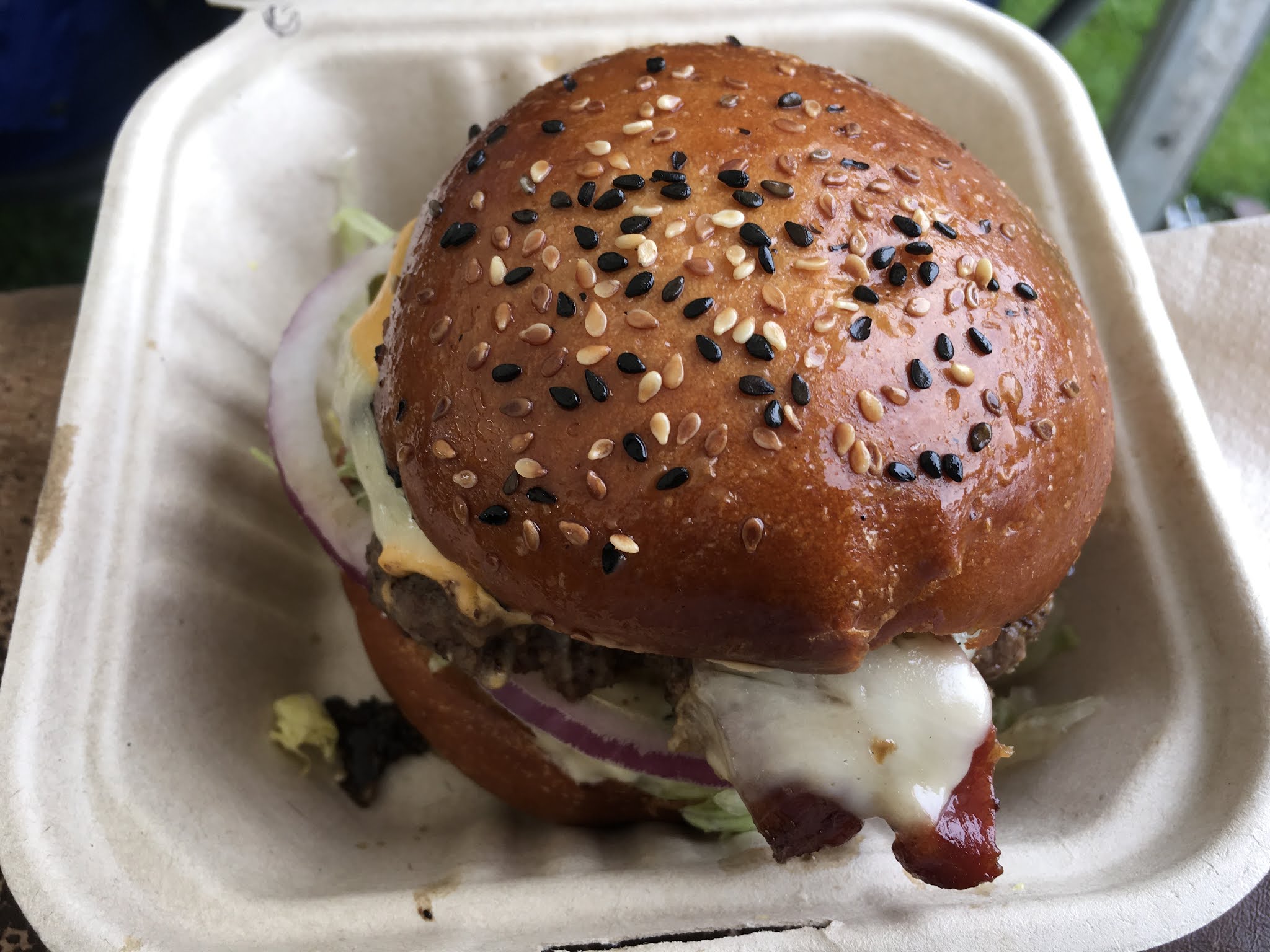
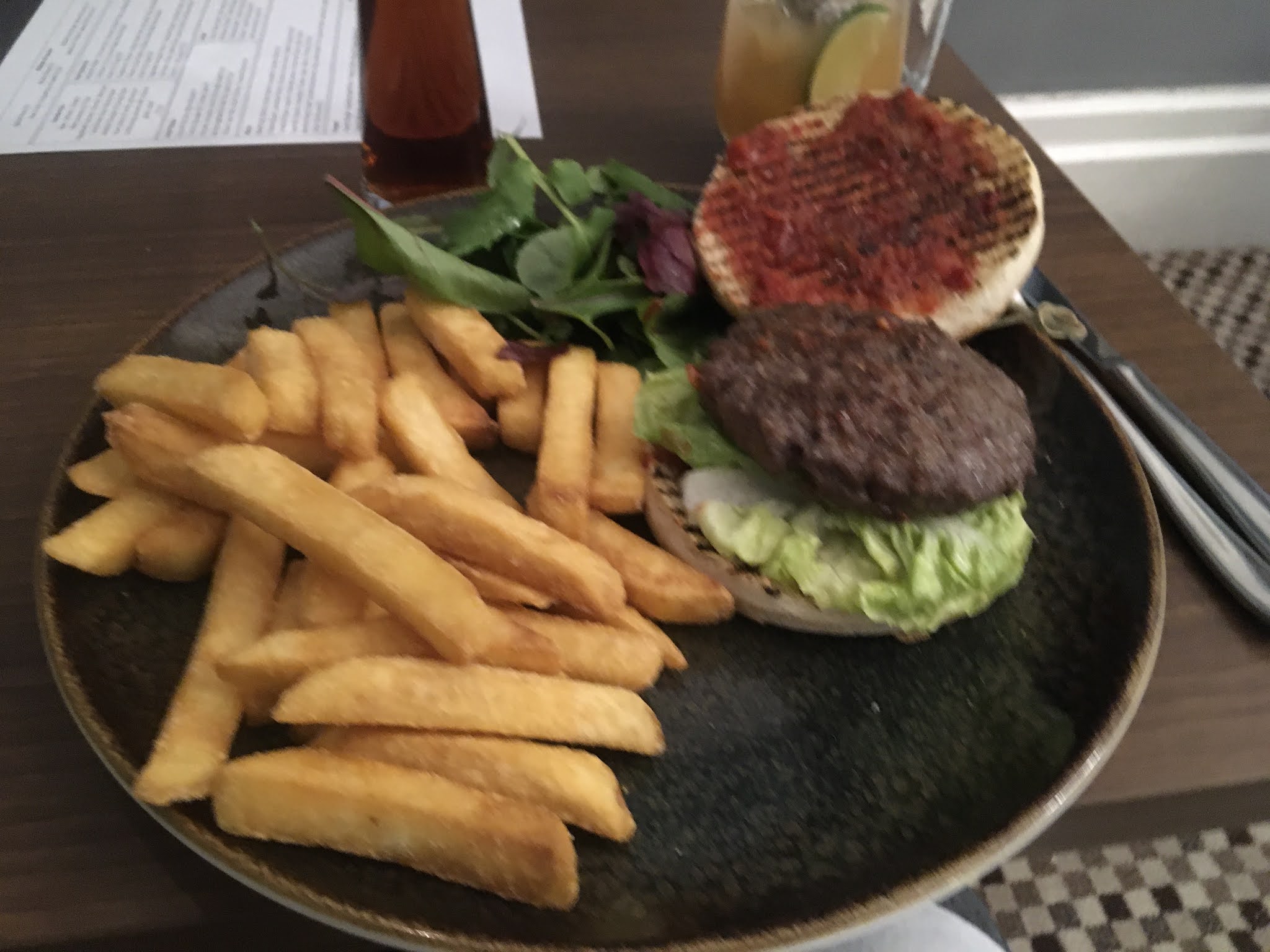
  In between listening to the talks, Lucy The Labrador and I toured the fast food stalls. Inevitably the longest queue was waiting at the Beefy Boys stall. My enthusiasm for burgers is usually only a little greater than my enthusiasm for food cooked sous vide but the previous evening I had had a perfect burger, precisely seasoned (which is the key) in the ‘Bistro’ (the former sitting room) of Fishmore Hall (it was accompanied by a sensuously delicious relish and very fine chips) and I resolved to see how the Beefy Boys burger matched up to the delight of the previous evening. I chose the Beefy Boys original burger - more simple and less encumbered with numerous additional ingredients - with its ‘original’ and ‘secret’ accompanying sauce. It was not really all that good. The Beefy Boys burger was desperately under-seasoned and the sauce unmemorable and really now one has to ask what all the fuss is about. Prize-winning in the past, I believe, but now nothing to place it in the firmament of great burgers. The number of customers queueing may say differently but it looks to me that the makers of this product have been living on old successes for far too long and need to take a long hard look at their tired product.

Beefy Boys burger, tired and underseasoned


The dog at least remained a fan


Fishmore burger, great chips, delicious relish


  The businesses occupying stalls at the Food Festival are little changed from previous years. There’s a wealth of local cheeses, ciders, ales, charcuterie, pies, meat, pottery, utensils, condiments, preserves, chutneys, relishes, breads, pastries, greengrocery and so on if you wish to buy. And very good it all lookks too. And of course there are countless opportunities to buy local gins from businesses around the area. Ludlow Gin is a major sponsor of the event but in name at least my favourite has to be Gun Dog Gin.


Saturday, 13 June 2020

99. World Gin Day.

The BBC, mostly quite dire, has its moments. Today’s Saturday Kitchen Live reminded me that it is World Gin Day, a beacon shining out across a turbulent sea of statue-demolishing and lurking viruses. What fun for Matt Tebbutt and Olly Smith and their guests to sink several glasses of gin and get paid for doing so. And of course it is the official birthday of one of the world most famous gin sippers - The Queen no less.
  Olly Smith waxed lyrical for various reasons about 4 different gins but was rather cool on the subject of one of my favourites, Tom gin. Well, each to their own. First he recommended the wannabe Gordon’s lookalike, Greyson’s, from Aldi on the basis of its drinkability for the excruciatingly modest price of £5.99 per bottle. Good for cocktails especially. It’s probably as authentic as Lymeswold cheese but then again I did really like Lymeswold.


Then on to the better quality and obviously rather more expensive London Dry Gin, Dartmouth, about which regular presenters and guests alike waxed lyrical.


  And then on, representing the flavoured gins, to the West Midlands gin, Chase farm’s Pink Grapefruit and Pomelo gin from Herefordshire, which I love served with tonic and a slice of pink grapefruit and a dish of green olives. I first tasted it while staying at the wonderful Fishmore Hall (home of Forrell’s) just outside Ludlow where I was staying for the 2019 Ludlow Food Festival and so in love with it was I that I had to buy a bottle from Chases’ stand at the festival. And so in love with it am I that have been forced to go and make myself a glass just now and remind myself of what a fabulous drink it is.
  Smith’s final recommendation was from London - well nobody’s perfect - the exquisite-sounding Mary-Le-Bone Orange and Geranium Gin. From Smith’s description this looks like a road to go down.


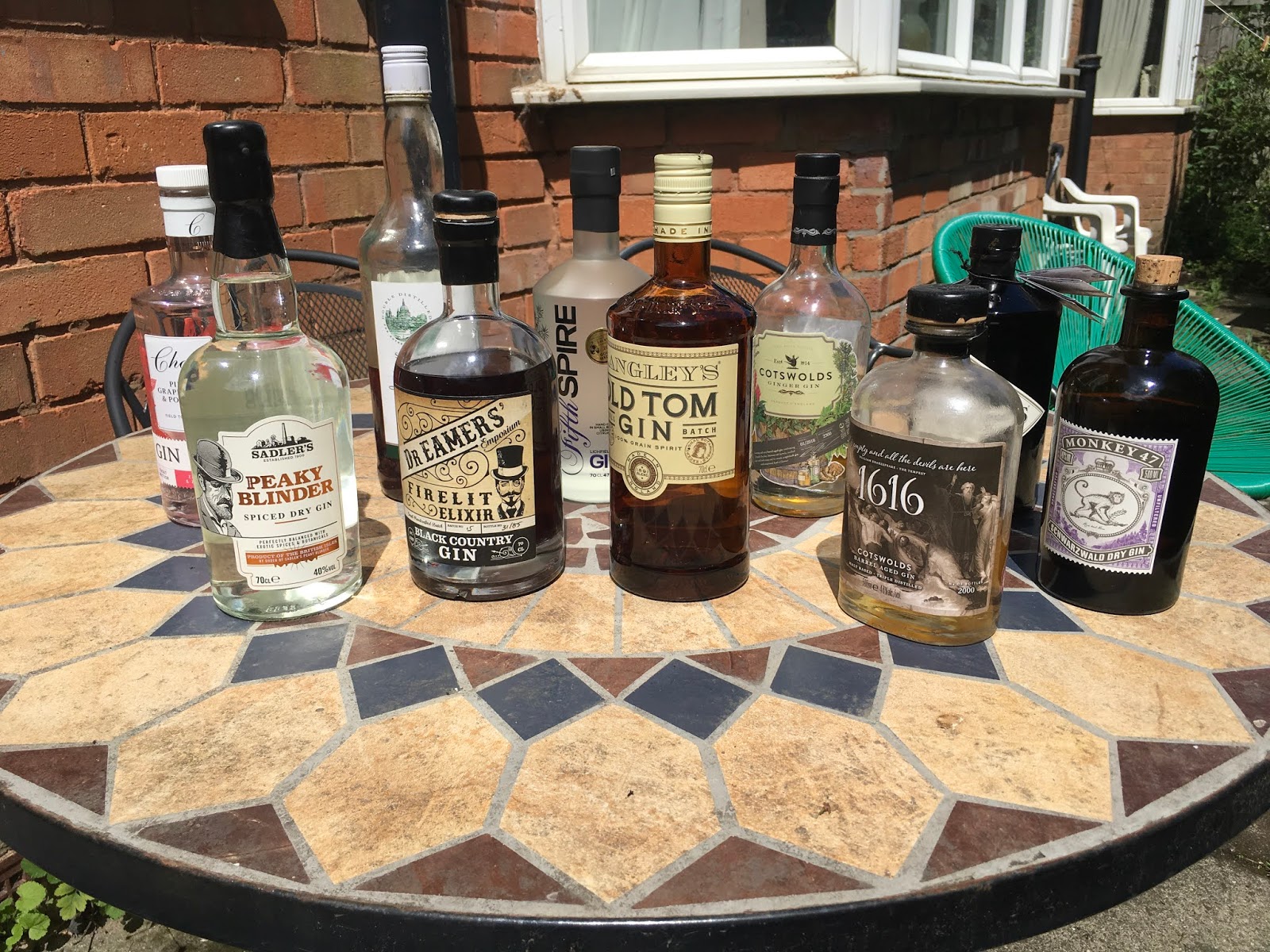
  But what of gin from the West Midlands? Well we’ve already mentioned Chase from Herefordshire. So forgive me for getting out some of my collection. Here in Birmingham, or at least nearby, we have Langley’s Old Tom, vital to make a Tom Collins, but to be appreciated for its sweetness just with tonic, which drove the population of 18th century England down its Hogarthian gin-soaked state of inertia.


From the Black Country I have bottles of colour-changing Dr Eamer’s Firelit Elixir Black Country Gin (citrus, juniper, coriander, angelica, orris and cassia); from Greywood Distillery in Lichfield there is Fifth Spire Gin (“handcrafted in small batches using citrus fruits”); Peaky Blinders Spiced Dry Gin (Sadler’s Brewery in Lye near Stourbridge) with the label joyously reading “Produce of the British Isles by order of Sadler’s Peaky Blinder” (what fun).


  We must not forget the fabulous Cotswold Gin from near Shipston-on-Stour in Worcestershire which is an excruciatingly delicious gin and which I first had the pleasure of sampling soon after its arrival on the scene at the wonderful No 33 The Scullery very soon after it opened in Stratford upon Avon. The distillery seems a little obsessed with its whiskeys and I think the gin was a step on the distillery’s road to whiskey production (we recall the whiskey-like 1616 Barrel-aged Gin, a part-bottle of which I still possess and know now that it assuredly does NOT go with tonic (I really should  read the details printed on the label). The 1616 gin was marketed as honouring Shakespeare on the 400th anniversary of his death and claims to reflect the style of gin of his time being distilled from malt spirit in pot stills with “juniper and select botanicals” and “aged in American oak wine barrels”. A gem to hold on to till the right moment. Currently also in my collection is a partly used bottle of Cotswold’s Ginger Gin flavoured with orange peel, candied ginger, honey, juniper, and  ‘woody spices’.


  Back to Herefordshire and a gin which usually has a stall at the Ludlow Food Festival Gun Dog Gin originating from Ledbury which I always like to visit. The rhubarb gin is a great pleasure to me.


  And from Bishops Castle in Shropshire I have a very nicely presented bottle Chilton Seville Orange Gin which I bought at Ludlow in a nice little sack bag. 


  So, as I leave the West Midlands for a second or two (metaphorically not physically, you understand), I confess that I have a special place in my heart for a glass of Hendrick’s and a nice little slice of cucumber and I still worship at the feet of Monkey 47, which I was informed by the excellent barman at Opheem, is best served with a slice of pink grapefruit and his belief on this matter was proven to be exactly correct. Of course if you go to Purnell’s Gingers Bar (pray to all that’s holy that it survives these difficult times) you can indulge yourself in a Glynn and Tonic which with Glynn Purnell’s wisdom is of course made from Monkey 47.


  Finally let us return to my little corner of Birmingham, on the edge of Worcestershire, and look at this unpromising bottle of Sainsbury’s Dry Gin and ask ourselves what exactly is inside. Answer:- my ten year old homemade Damson Gin. Made with damsons grown from trees in the garden and really rather fine. The good news is that, after a couple of terrible years, the damsons are growing beautifully this year ready for a new batch of damson gin to be made as the year moves along. So this really is a rather enjoyable World Gin Day.


Sunday, 2 February 2020

76. New Stratford, Old Stratford.


  After a rather larger-than-I-expected Ploughman’s lunch at the the Old Thatch Tavern (see Blog 75) I used my afternoon in Stratford upon Avon walking Lucy The Labrador up to Holy Trinity Church, last resting place of possibly the West Midland’s greatest historical figure, William Shakespeare, and in the evening walked the 100 or so yards from the wonderfully atmospheric and ancient Shakespeare Hotel which is one of the few Stratford hotels to welcome dogs and their humans, to The Woodsman restaurant situated in the also ancient Falcon (now the Hotel Indigo Falcon) to see what dinner there would be like having previously visited there for lunch (see Blog 67) back at the end of September 2019.
  It too was very atmospheric as one stepped out of the dark late January evening Chapel Street with the vague feel of drizzle in the air into the lively, warm, brightness of the Woodsman’s dining room with its open kitchen giving full view to the two chefs toiling over the large wood fire ovens stirring  their little sauce pans and arranging the fruits of their work on plates and summoning the bustling waiters to deliver the service.
  There really did seem to be a veritable ant colony of waiting staff walking around in all directions like a scene from an Eisenstein film. I noticed an unfortunate stuffed weasel in one corner of the room. When I say stuffed I do not mean that it was content and overfed rather that it was dead, discontented and had experienced the attentions of a taxidermist with whom it would probably have preferred not to have had any contact. I thought it was a rather strange item to have in a dining room but perhaps people like to have stuffed weasels around them when they’re eating an expensive meal. And anyway he did look like quite a nice weasel with a pleasant little smile on his face - not at all like the nasty stoats and weasels you read about in Toad Of Toad Hall.


  The theatre of the drinks trolley took place - apparently the negroni is something to experience but I settled for a less thrilling Elderwood g and t - and then a young woman plopped a couple of slices of bread with some butter on the table with none of the usual detailed explanation - which actually I would quite liked to have been given - of the nature of the bread or the special peculiarity of the butter. The delivery of the bread, conducted in silence, contrasted with the dramatic monologue, RSC-style, delivered when the drinks trolley was doing its rounds.


  I chose as starter a very fine terrine of local game birds and root vegetables served with Yorkshire rhubarb and granola. I shan’t go on about textures and flavours save to say in all such quarters this was a splendid starter and, as can be seen, a pretty dish too.


  I knew I should have had some of the local game for my main course as that is The Woodsman’s true raison d’etre and one probably isn’t doing justice to the place if one opts for the fish but I did and that’s that. I chose the Grilled halibut tranch. ‘Tranch’ was the giveaway. Dishes at The Woodsman are relatively expensive but the diner can not complain about ungenerous helpings.
The halibut was well-cooked but the size of the portion was so great that I began to tire of it and the last few forkfuls were hard to accomplish. The fish was accompanied by a smidgeon of red wine sauce and more of the sauce would have helped and there was also some salsify which is a vegetable about which I have my reservations when it comes to the flavour department and black trompette mushrooms and some sea herbs. I congratulated myself on forgetting to order a side-dish of the Woodsman’s excruciatingly delicious ‘dirty mash’ which, although it is a wondrous creation, would have thrown me over the edge of excessive consumption. When I first saw the dish the word ‘magnificent’ came to my mind but, I learned, you can have just a little too much magnificence in your life. It was a very satisfactory main course but I shall be careful not to have something which calls itself a ‘tranch’ in the future. 
  For dessert I had a fine fool with slices of blood orange lurking delightfully in its depths. Again it was quite a generously sized dessert but I battled my way to an emptied dish nonetheless.
  I think the Woodsman has its faults though a true trencherman would find it difficult to agree with me. But I do like The Woodsman. I think it’s delivering the sort of food to diners’ tables which an English restaurant should be delivering at the beginning of the 2020s. The atmosphere, particularly on a dark winter’s evening, is absolutely spot on. All the tables in the area  of the kitchen were occupied and all my fellow diners looked rather pleased about things.


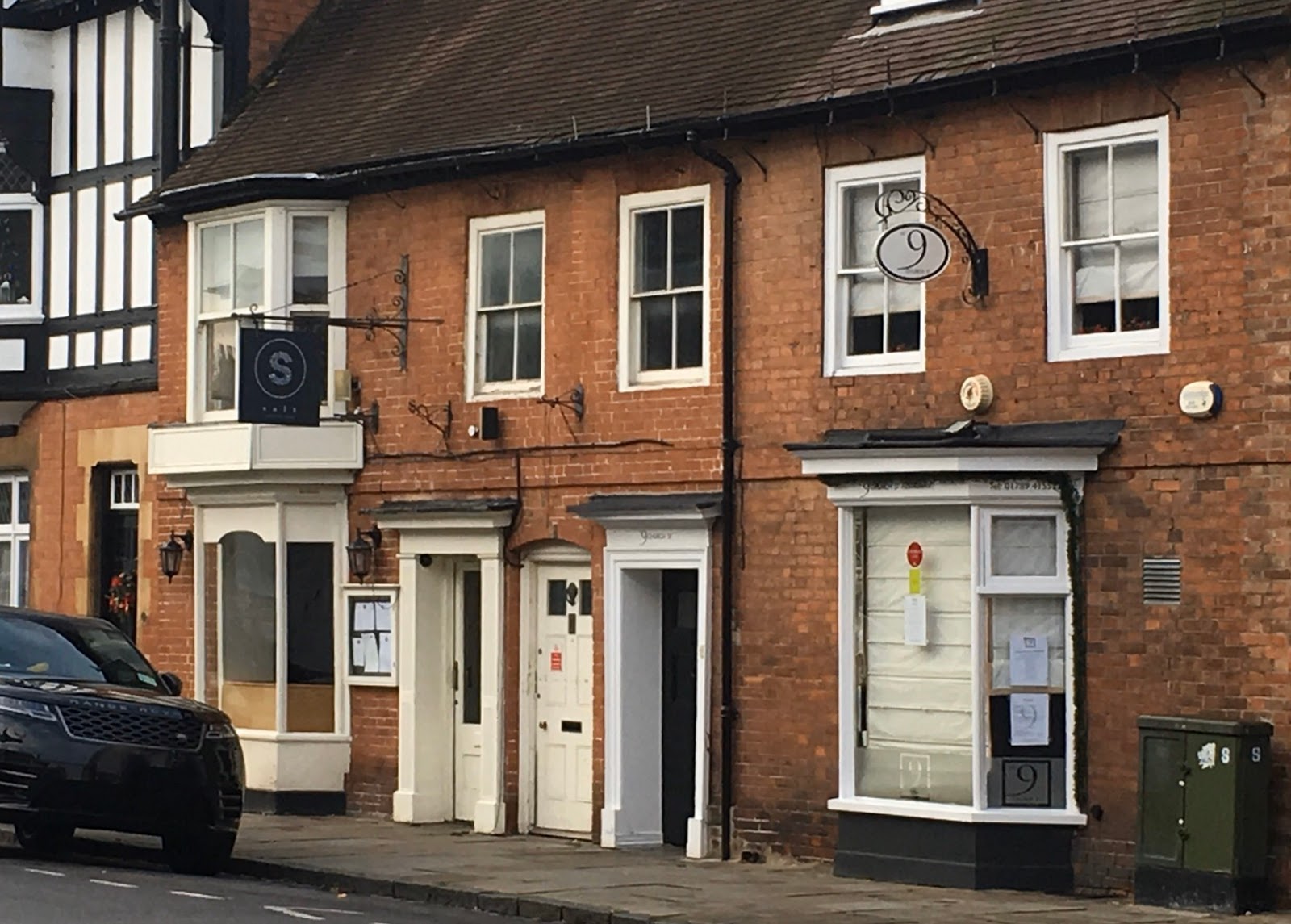
  The following evening, having decided to eschew the professional critics’ darling, Salt, on the grounds that I went a couple of times soon after it was opened and, while having been impressed with the food, was less so with the service whereby the young people waiting there didn’t really seem to get it. I won’t elaborate but merely state that instead I dined at the doyen of Stratford’s fine food, ten years old this year, Wayne Thomson’s petite but perfectly formed No 9 Church Street, next door to which Paul Foster chose to open Salt. It must be a challenge being the fine dining restaurant situated immediately next door to a Michelin-starred Restaurant even if you do have a Michelin plate yourself especially when you’ve been around a lot longer than the upstart neighbour. Luckily No 9 seems to have a long-established clientele and an accomplished restaurant manager in the form of Magda Maciaszczyk who charmingly makes one feel comfortable and welcome at the restaurant in a way that one does not experience next door at Salt.


  With a micro-bar downstairs one climbs an ancient staircase to arrive at the comfortable and pleasant dining room. One feels relieved to be sitting there waiting for one’s food to arrive rather than waiting there delivering the food to the diners’ tables and doubtless running up and downstairs all evening. To wait at No 9 you need to be fit.
  I’ve been dining at No 9 now for at least five years on and off. Wayne Thomson’s food is interesting - when it’s good it’s wonderful but not every new dish hits the mark and some ingredient combinations do not always work together even though on paper they probably should do. But it’s nice to have something new and original and to able to draw one’s own conclusions about what’s on the menu. There’s always a couple of slices of bread and some olives to start which see you through to the arrival of the starter. Mine was an excellent example of what to do with pigs cheeks - ‘Thai-glazed with pickled Asian vegetables and spiced pineapple’ which really made the dish. This was a bountiful plate of food, a generously proportioned pigs cheek (I’ve been served smaller pieces of the meat as a main course) with the meat perfectly cooked and the vegetables perfect accompaniments.


  The main course sadly, in contrast, did not really work for me - charred salmon, chorizo and red onion compote, crispy new potatoes and broccoli. I couldn’t find the salmon, very nicely cooked as it was, to be a happy companion to the chorizo and onion - it was a combination that really didn’t work for me - and the broccoli seemed to add to the confusion of the mixture. Most straightforward were the sautéed potatoes but the description of them as ‘crispy’ was wholly inaccurate. This was a main course of four parts sitting uncomfortably together on the plate.
  I finished off with two happy little scoops of homemade ice cream - a happy pairing of coconut and clotted cream flavours (several other flavours were available). I think the generosity of the size of the pigs cheek had rendered me incapable of having a larger pudding though I gazed longingly at the delightful-looking desserts which were delivered to the happy people sitting at the table next to me.
  I do like No 9 Church Street. It has been there for ten years so Wayne Thomson must be doing something right even when a talented culinary newcomer arrives and sets up shop next door on his doorstep. A new spring menu has just been introduced so I look forward to giving that a try soon.