Saturday, 13 June 2020

100. Food And Art.


  The presentation of food in fine dining restaurants usually involves the creation of an extraordinary visually interesting and attractive item on the plate and the design of the plate itself is part of the visual spectacle (some chefs involve themselves with the design and production of their restaurant’s ceramics). It isn’t unusual to see diners glancing at each other when a dish is presented with near-wondrous expressions on their faces and whispered words of amazement and pleasure (if the chef has been successful in achieving his/her visual goal). I’m still surprised how positively diners react to that old visual standby of wafting clouds of liquid carbon dioxide. Presentation of food is certainly a visual art in the hands of the right person.
  But I do not want to talk about that side of the art of food, rather the non-edible aspect of it which seems to have been coming to the fore in the past few weeks during this infernal lockdown (I’m not complaining about it, I for one do not want my latest visit to a restaurant to turn to be my last meal if the virus is lurking there).
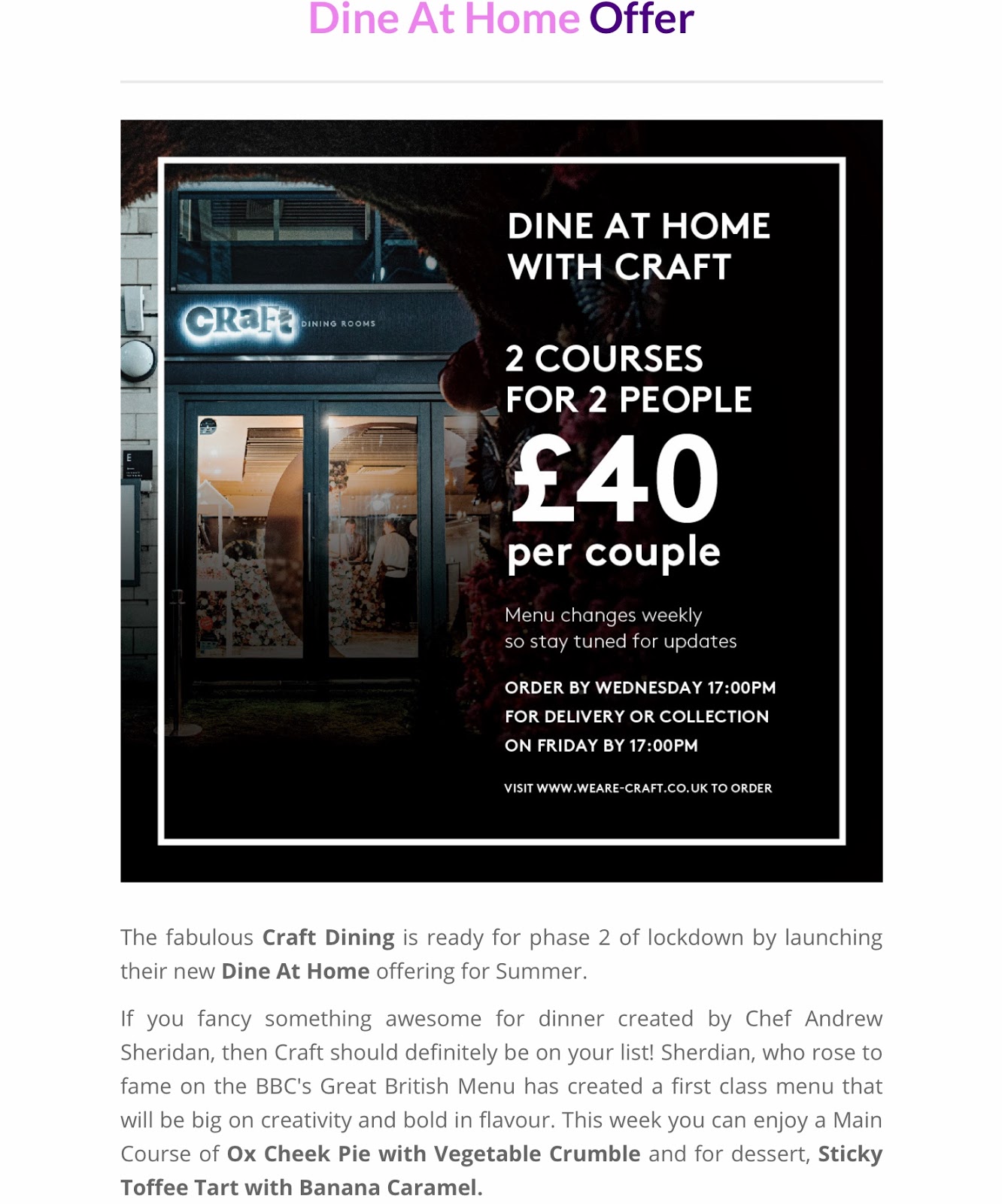
  Chefs and restaurant owners seem to be turning to art to keep their presence in the public eye and tell us what they are up to to prepare for a new way of dining out. Take for instance the splendid cartoon depicted above which has been used by Craft Dining Rooms to remind us that the restaurant is still here and doing its best to make its diners safe for when the moment comes for reopening. A simple yet easily recognised rendition of the restaurant’s entrance and its outdoor pods (about which I felt very cynical when they first appeared last year but now they seem like an incredibly clever idea) executed in a chic style which reminds me of cartoons of the 1970s. 
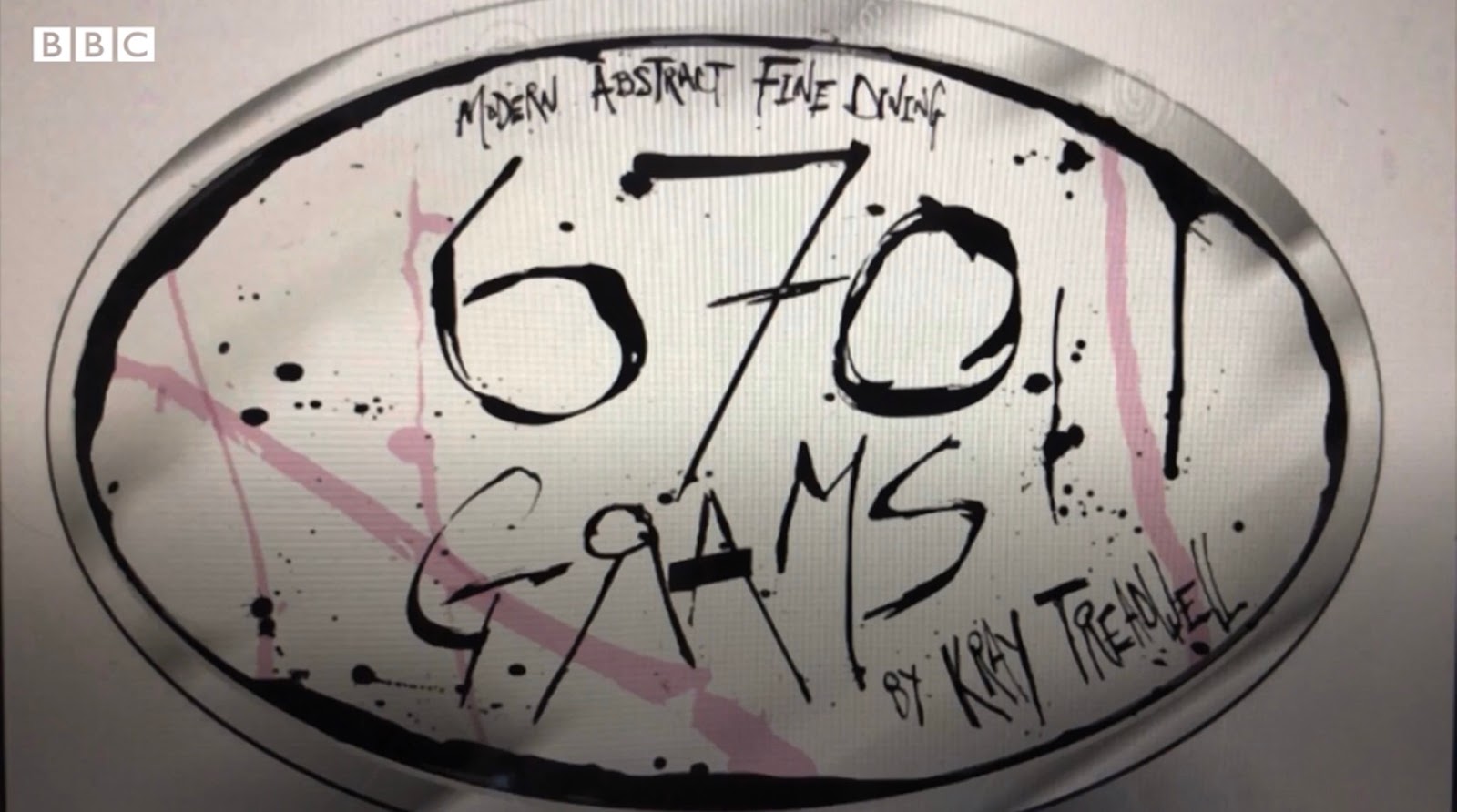
  And Kray Tredwell, clearly champing at the bit to get his new restaurant, 670 Grams, swinging its doors open to its first customers, has adopted an anarchic, eye-catching motif which clearly says everything about what he wants to achieve with his food and which reminds me of a cross between a Jackson Pollock-inspired plate of food by Michael O’Hare and the cartoons of Ralph Steadman.


  Brad Carter of Carters Of Moseley too has been exploring art in his communications with customers. A few weeks ago a colourfully cosy cartoon of his restaurant by night bathed in a reassuring warm light was used in email sent to his customers and he has also been using some very accomplished photography to promote his weekly programme of selling high quality ingredients linked to instructions on how to prepare it to create a Carters-style meal.


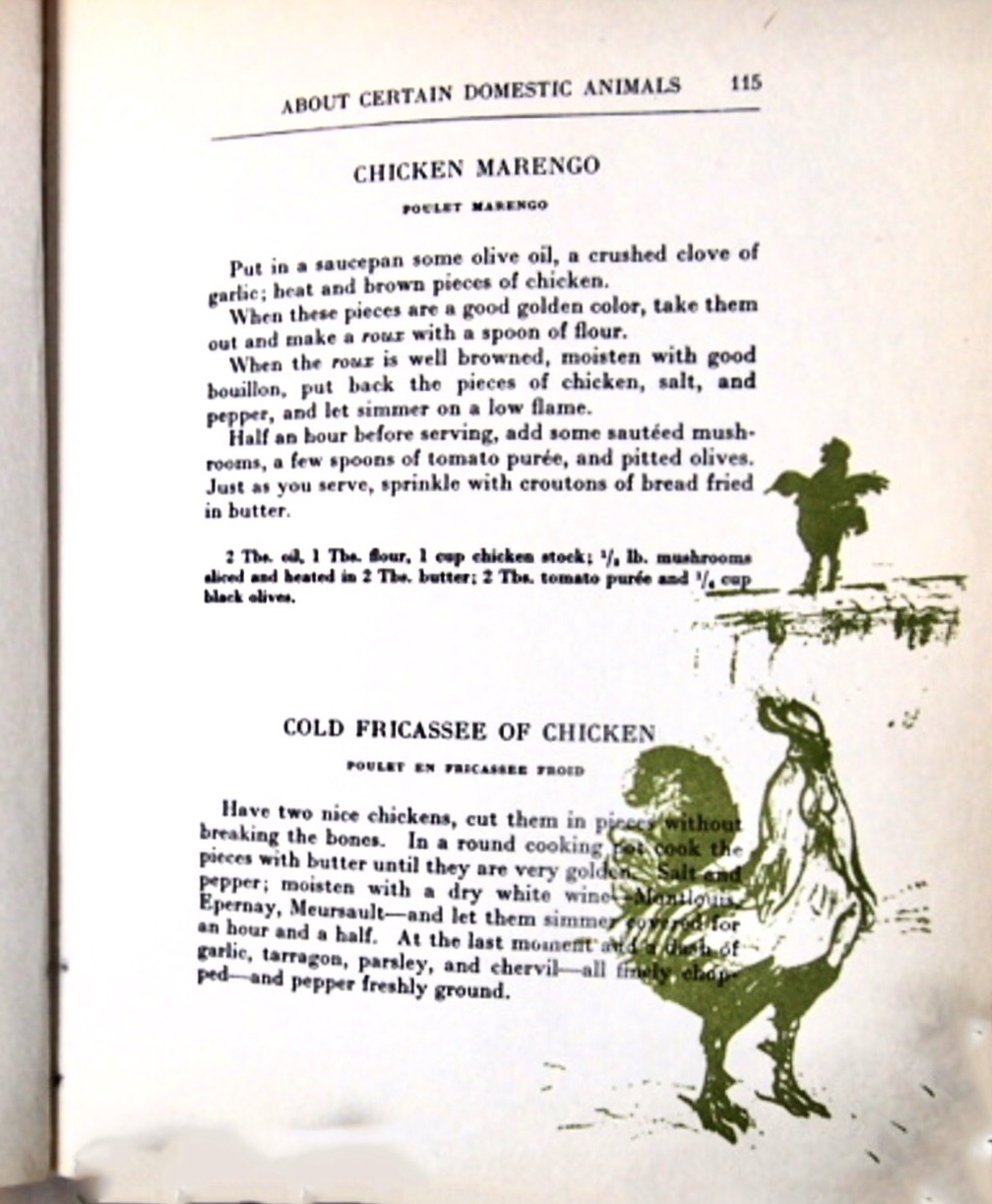
  The artist Henry (so his mother named him, she being English) Toulouse-Lautrec, famous more perhaps for his portraiture of alcohol drinking than food consumption itself, is a character who indisputably has no links with The West Midlands but was pleasingly suitably hedonistic and epicurean for modern fine diners and gourmands to identify themselves with (though not to the extent that they should aim to expire from a combination of alcoholic liver disease and syphilis as did Henry). But in a discussion of Art and Food he is worthy of a mention even if his favourite English restaurants were to be found in London rather than the nation’s workshop.
  TL, from a highly privileged background, similar to a lot of today’s Labour politicians or denizens of Moseley, was sent vast amounts of food from his rural family and enjoyed preparing it to make lavish repasts. He recorded his recipes and planned to publish them in a book but was thwarted by rotting away at the age of 36. Maurice Joyant, his art dealer, discovered the recipes after his death and subsequently published them. A lavish and beautifully illustrated edition in English was published in 1966.
  His recipes were not necessarily for the faint-hearted - such not-now-to-be-tried recipes as heron grilled over a vine (unlikely even to surface in the rock and roll blackness that is The Wilderness) and a Fresh squirrel dish come to mind. And the chef at Pulperia (if it ever opens properly) might have his or her mind boggled by steak à la Toulouse which to be cooked to perfection requires a vine-wood fire and three tranches of steak, all smothered in Dijon mustard, and then piled on top of each other and grilled together on the vine-wood fire until the edges of all three are blackened at which point the outer two steaks are discarded. The middle steak should then be perfection personified.
  TL rarely ate in Paris restaurants as he enjoyed the food he prepared himself rather more but when he crossed La Manche and stayed in London he enjoyed dining out at restaurants including the Café Royale where he met Oscar Wilde whose tastes were equally Epicurean and The Criterion but the place at which he most liked to dine was Sweeting’s, a noted fish restaurant. His greatest delight there was Skate wings with Black butter and he wrote joyous letters home praising the dish.
  It’s interesting that TL was able to derive such pleasure from dining out in England - it rather flies in the face of the long-standing tale that English food has always been poor to dire.


  The English edition of Toulouse-Lautrec’s book, The Art of Cuisine, is exquisite and a must for any food lover’s bookshelves. Like many dishes presented at our West Midlands fine restaurants the book is a visual delight first and then the rest follows.


 I think that our restaurant owners and chef patrons could pursue the visual arts more - TL-style or otherwise - gay (in the old sense of the word) and bold and colourful in presenting themselves to the hesitant diners of Birmingham as they try to draw them out of their secure homes back into their dining rooms. They’ve made a start but there must be some furloughed TL-wannabe artists out there who could help to boost a rocket-propelled take-off for our dining out trade.

At the Café La Mie, painted c.1891

Monsieur Boileau at the Café, 1893

  Food on a plate as art is principally uniquely gustatory and olfactory but our first reaction to it is usually visual - as art it is the culinary equivalent of painting. But one special area of food presentation which should be mentioned is patisserie which in itself is a form of sculpture. So I am pleased to see that the marvellous Mary Ashman (Maz) the baker and Dalvinder Cheema (Dali) the decorator here in remote West Heath, have found ways of continuing their business during Lockdown (what an annoying piece of terminology) by home delivery not only of their exemplary cakes but also afternoon teas.
  Cuisine as art - you need sculpture in your gallery as much as paintings).


99. World Gin Day.

The BBC, mostly quite dire, has its moments. Today’s Saturday Kitchen Live reminded me that it is World Gin Day, a beacon shining out across a turbulent sea of statue-demolishing and lurking viruses. What fun for Matt Tebbutt and Olly Smith and their guests to sink several glasses of gin and get paid for doing so. And of course it is the official birthday of one of the world most famous gin sippers - The Queen no less.
  Olly Smith waxed lyrical for various reasons about 4 different gins but was rather cool on the subject of one of my favourites, Tom gin. Well, each to their own. First he recommended the wannabe Gordon’s lookalike, Greyson’s, from Aldi on the basis of its drinkability for the excruciatingly modest price of £5.99 per bottle. Good for cocktails especially. It’s probably as authentic as Lymeswold cheese but then again I did really like Lymeswold.


Then on to the better quality and obviously rather more expensive London Dry Gin, Dartmouth, about which regular presenters and guests alike waxed lyrical.


  And then on, representing the flavoured gins, to the West Midlands gin, Chase farm’s Pink Grapefruit and Pomelo gin from Herefordshire, which I love served with tonic and a slice of pink grapefruit and a dish of green olives. I first tasted it while staying at the wonderful Fishmore Hall (home of Forrell’s) just outside Ludlow where I was staying for the 2019 Ludlow Food Festival and so in love with it was I that I had to buy a bottle from Chases’ stand at the festival. And so in love with it am I that have been forced to go and make myself a glass just now and remind myself of what a fabulous drink it is.
  Smith’s final recommendation was from London - well nobody’s perfect - the exquisite-sounding Mary-Le-Bone Orange and Geranium Gin. From Smith’s description this looks like a road to go down.


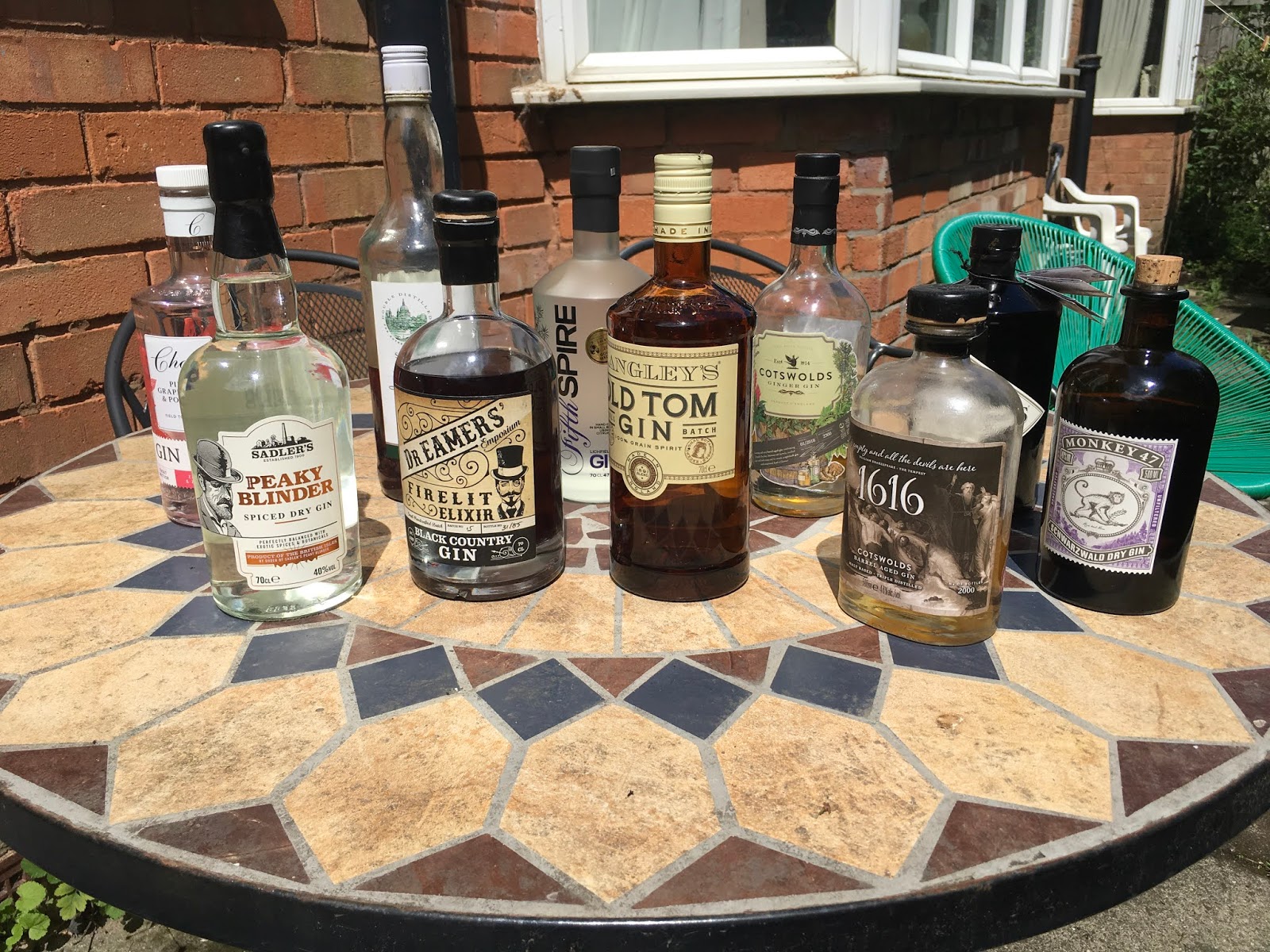
  But what of gin from the West Midlands? Well we’ve already mentioned Chase from Herefordshire. So forgive me for getting out some of my collection. Here in Birmingham, or at least nearby, we have Langley’s Old Tom, vital to make a Tom Collins, but to be appreciated for its sweetness just with tonic, which drove the population of 18th century England down its Hogarthian gin-soaked state of inertia.


From the Black Country I have bottles of colour-changing Dr Eamer’s Firelit Elixir Black Country Gin (citrus, juniper, coriander, angelica, orris and cassia); from Greywood Distillery in Lichfield there is Fifth Spire Gin (“handcrafted in small batches using citrus fruits”); Peaky Blinders Spiced Dry Gin (Sadler’s Brewery in Lye near Stourbridge) with the label joyously reading “Produce of the British Isles by order of Sadler’s Peaky Blinder” (what fun).


  We must not forget the fabulous Cotswold Gin from near Shipston-on-Stour in Worcestershire which is an excruciatingly delicious gin and which I first had the pleasure of sampling soon after its arrival on the scene at the wonderful No 33 The Scullery very soon after it opened in Stratford upon Avon. The distillery seems a little obsessed with its whiskeys and I think the gin was a step on the distillery’s road to whiskey production (we recall the whiskey-like 1616 Barrel-aged Gin, a part-bottle of which I still possess and know now that it assuredly does NOT go with tonic (I really should  read the details printed on the label). The 1616 gin was marketed as honouring Shakespeare on the 400th anniversary of his death and claims to reflect the style of gin of his time being distilled from malt spirit in pot stills with “juniper and select botanicals” and “aged in American oak wine barrels”. A gem to hold on to till the right moment. Currently also in my collection is a partly used bottle of Cotswold’s Ginger Gin flavoured with orange peel, candied ginger, honey, juniper, and  ‘woody spices’.


  Back to Herefordshire and a gin which usually has a stall at the Ludlow Food Festival Gun Dog Gin originating from Ledbury which I always like to visit. The rhubarb gin is a great pleasure to me.


  And from Bishops Castle in Shropshire I have a very nicely presented bottle Chilton Seville Orange Gin which I bought at Ludlow in a nice little sack bag. 


  So, as I leave the West Midlands for a second or two (metaphorically not physically, you understand), I confess that I have a special place in my heart for a glass of Hendrick’s and a nice little slice of cucumber and I still worship at the feet of Monkey 47, which I was informed by the excellent barman at Opheem, is best served with a slice of pink grapefruit and his belief on this matter was proven to be exactly correct. Of course if you go to Purnell’s Gingers Bar (pray to all that’s holy that it survives these difficult times) you can indulge yourself in a Glynn and Tonic which with Glynn Purnell’s wisdom is of course made from Monkey 47.


  Finally let us return to my little corner of Birmingham, on the edge of Worcestershire, and look at this unpromising bottle of Sainsbury’s Dry Gin and ask ourselves what exactly is inside. Answer:- my ten year old homemade Damson Gin. Made with damsons grown from trees in the garden and really rather fine. The good news is that, after a couple of terrible years, the damsons are growing beautifully this year ready for a new batch of damson gin to be made as the year moves along. So this really is a rather enjoyable World Gin Day.


Wednesday, 10 June 2020

98. London Restaurants Feeling The Heat Of COVID-19.


  As statues of 18th century slave owners which have stood for 200 years across Britain begin to disappear in the swell of the tide of protests against racism, one not necessarily foreseen outcome of the COVID-19 pandemic, so other symbols of privilege - ludicrously overpriced London restaurants are beginning to feel the heat. Much loved by London-centric Michelin, but already dumped by the 2019 The Fifty Best Restaurants in the World List, formerly prestigious London restaurants, previously delighted to squeeze wealthy international travellers and gastrotourists and the wealthy Londoner elite (now hiding away in their second or third or fourth or fifth home somewhere in Scotland or Cornwall or the Cotswolds) for every £50 note they can, are facing the end of their glory days.
  Thus the two Michelin-starred The Ledbury is now closed indefinitely as its Chef patron, Brett Graham, declared that it was impossible to keep the restaurant open because of the government’s social distancing measures and he has fired all his staff but is holding on to the lease for the present. the Ledbury hah held its two Michelin stars longer than any other restaurant in London apart from Le Gavroche and first opened about 15 years ago.
  Quite simply, London now has far, far too many restaurants. With international travel suspended it is clear that there are not enough local inhabitants to keep the thousands of restaurants in the capital alive over the next couple of years. And with the prices in so many of them being exorbitant the numbers of their potential clientele is minuscule. Furthermore those in the know are already ditching London in a big way. The latest Fifty Best Restaurants In The World list gave London the elbow when it placed only two of the city’s restaurants in the legendary Fifty - both in Shoreditch (The Clove Club and Lyle’s) with a taste for ‘Modern British’ cuisine, with Spanish or Nordic or Far Eastern influences rather than being derivative of the sort of stuff the French have long presented to the world as the (dubious) peak of gastronomy. Thus the likes of Dinner by Heston Blumenthal and The Ledbury were pitched from their top fifty places with the latter down to no. 68.


  Here in Birmingham the number of true Fine Dining restaurants, mostly serving exceptional food at realistic prices but undervalued by the London-loving Michelin, can be counted on the fingers of less than two hands. There should be enough local diners around wishing to enjoy the pleasures of Birmingham’s very special restaurants to enable the restaurants not only to reopen but to thrive and flourish. We have some exciting new chefs just waiting for the current crisis to finish to open their new restaurants and of course there are Birmingham’s great already well-established restaurants on the scene which their regular diners are just itching to get back to. Perhaps some of the promising young Midlands chefs who thought their future lay in a career in London will think of coming back to the West Midlands as the London restaurant scene begins to sink.
  It’s been an awful time and bad things aren’t over yet, but the Birmingham food scene could emerge enriched and hopefully better appreciated than it ever has been before. Giles Coren, who claims to have given up being a food critic, may after all find peace among the “One eyes” who enjoy West Midlands gastronomy. And the likely collapse of the London dining food scene gives impetus to the campaign of the quite excellent and pleasingly influential West Midlands mayor, Andy Street, to make the region the place where the hospitality industry kickstarts the economy again.

Thursday, 4 June 2020

97. West Midlands Mayor Calls For Birmingham To Kick Start Hospitality Industry.

  Diners and food business owners remain full of expectation indulging in optimistic speculation about the imminent reopening of restaurants. Politicians are also keen to see the hospitality industry get restarted given that in the West Midlands alone 135000 jobs are provided by that industry and it contributes £12.6 billion per year to the local economy. Now the Birmingham Post reports that the notable West Midlands mayor, Andy Street, has called on the government to allow the region to become the first area in the country to reopen its public houses and restaurants, “This way, we can lead the way and help strike the right balance between safety and outputs, allowing other regions to follow suit. It’s important for the West Midlands to build on its unique heritage and distinctive strengths and seize the opportunity to reset, rebuild and reinvent our region, and come back even stronger”.


  I have my doubts. Being an old bloke, and much favoured by COVID-19 as potential prey, I don’t really want my first post-lock down fine dining meal to be my last. And COVID certainly has not gone away in these parts and it’s just as nasty and murderous as it was 3 months ago. Some Birmingham restaurants, Craft Dining Rooms and The Wilderness, are making reservations in anticipation of an early July starting gun being fired. They could be right and I have speculatively made bookings at both though for a little while after they open so somebody else can dip their toes in the water before I take the plunge and the table I have reserved at Craft Dining Rooms is outside.
  Craft Dining Rooms has indicated that it will put in a lot of measures to ensure that diners will be as safe as possible when it reopens its doors to them including temperature testing (of the diners not the food) and in the meantime has introduced a takeaway service with a very reasonably priced 2 two course meals for £40.


  Meanwhile Carter’s of Moseley, at the top of trendy people’s favourite Birmingham restaurant list, has been selling extravagant and extravagantly priced ingredients so that the well heeled socialists of Moseley and Harborne and the slightly less well heeled socialists of Kings Heath can cook their own Michelin-starred barbecues. Well done to Brad Carter for his good business sense.


  At The Wilderness Alex Claridge has been offering bespoke 3 hour-long home cooking lessons via the internet and has opened his reservation book to post-Lockdown customer-hopefuls (I’m one of them).


  And Kray Tredwell and Stuart Deeley have been giving a number of interviews about their plans for their new restaurants the openings of which have been necessarily delayed by COVID-19. Kray has a nice byline - Fancy Common Food by Kray Tredwell. Though he also has Modern Abstract Fine Dining from Kray Tredwell which is nicely intriguing.


  Finally we might note a recent Birmingham Post article which reported on an interview with Aktar Islam of the sublime Opheem who gave a gloomy prognosis for the future of Birmingham restaurants as a result of the COVID-19 problem especially as his new Pulperia had only just opened prior to the Lockdown with the result, one assumes, that it was bleeding money. Let’s hope he’s wrong. There are many determined chefs and restaurant owners in the West Midlands whose efforts in the last few weeks may have saved their businesses and our regional Dining scene. This is another chapter in the story of dining out in the West Midlands. Perhaps Andy Street’s intervention may tip the balance in their favour.


Pulperia has recently started a takeaway Sunday lunch service


Tuesday, 19 May 2020

96. Lockdown Diversions

  The ninth week. Things are starting to get difficult. Food is being consumed increasingly greedily; the labrador, herself a seasoned gourmande, takes one look at me and hurries off in the opposite direction believing, I think, that I might be sizing her up as an interesting new dish to try as this denial of the delicious drags on.
  Those who share this denial will know that various and increasingly numerous chefs are offering various forms of takeaway in this city but when you live 7 miles away in the extreme suburbs, a stone’s throw away from the border of the immediately rural Worcestershire, there’s little chance of a fine city restaurant delivering food as far out as this relative backwater. My suburb is to Birmingham what Vladivostok is to Moscow.
  The nearest supermarket is about 2 miles away and I’m not prepared to walk there and back. There are times I wish I drove a car. There’s an hourly bus but the government tells us not to use public transport though it would probably be as safe as being at home since it does not seem to have had any passengers for the last 8 weeks. But old men in the second half of their sixties are greatly at risk from the virus though the government excludes us from its concerns, drawing the line at 70 and above, and I’m not prepared to risk going to the supermarket yet even if I had wings and could fly there.
  And Sainsbury’s, which this particular supermarket is and whose loyal customer I’ve been, quite literally, for decades will not deliver to me and summarily dismisses me with an onscreen message shooing me away from it telling me that I’m not the right sort for them - too young I guess. Well if things ever do return to normal, and I suppose they will, I’ll repay Sainsbury’s loyalty to me with the same sort of loyalty to them - I’ll shop at Tesco which has managed to make a couple of deliveries to me and clearly has risen brilliantly to meet the needs of Britain’s shoppers.
  As I had a 10 day wait for my next Tesco delivery and the amount in my cupboards of one or two necessities was starting to look a little precarious I visited a couple of other sites. The message from Sainsbury’s telling me where to go was unchanged and uncompromising and I searched on and came to Iceland (no not the home of our former cod war enemies) and I was very impressed by their ability to make a delivery to me the following day. So I had a good look at what was on offer.
  These days it’s rare for me to have a ready meal but the Iceland ‘luxury’ range looked quite promising. Today I had the first of my lockdown ready meal purchases - sadly, this story does not have a happy ending. I really wanted to enjoy this dish as Iceland had at least taken the trouble to deliver it unlike the hopeless Sainsbury’s. ‘Sri Lankan chicken curry and rice’ - sounds distinctly promising. Following the instructions closely I was able to plate up some very acceptable Basmati rice and some very decent chicken of a nice texture and a pleasant-looking sauce. But then the flavour hit me, or rather it didn’t hit me. The dish was extraordinarily bland. Eventually a mild heat came through but experienced not in my mouth but in my stomach. It was only at the end of the meal that I was aware of some heat in my mouth. And there was not the merest hint of another detectable spice.I do not understand why the meal was so tasteless given that there are so many spices in the dish according to the ingredients information on the back (and no I haven’t got one of the symptoms of COVID-19 - loss of taste - I can taste everything else I eat). I can only conclude that the spices and coconut and so on were included in homeopathic doses.
  If the flavour of the dish had had more zing about it this would have been a perfectly satisfactory meal but really it’s just too dull to consider ever buying this particular ready meal again. If the chef who prepared it had presented it on The Great British Menu I fear that he/she would only have received 5 points for it unless Marcus Wareing  had been judging it in which case it would have been 4 or less.


  As to other ways of diverting my attention from the urges to seat myself at a table in a fine restaurant my trawling through old Michelin Guides continues and very interesting it is too. Today I started off at the West Midlands’ first ever Michelin star winner, the Dining Room at Mallory Court five miles outside Leamington Spa (held a star from 1980 to 1994 and again from 2003 to 2013). I read that the fairly recently appointed Head Chef there, Paul Evans, is working to try to reclaim the hotel’s twice held star and, given that the hotel is dog-friendly I suspect that Lucy the Labrador and I will be heading in the direction of that part of Warwickshire once things are more normal and safe. The hotel has two well thought of places to eat - The Dining Room itself and also a bistro - so a stay there sounds quite promising.

Paul Evans Head Chef at Mallory Court.

  I also stumbled on a piece about another promising place to eat in Leamington - The Tame Hare in Warwick Street which was opened by the young chef Jonathan Mills and his father, Simon Haigh. Some alluring-sounding dishes appear to be served up there so three nights in Leamington sounds like a good idea to try all three of these places. 
  Well, I’ve distracted myself from my fine food lust for a few minutes. It’s the best one could hope for.

Jonathan Mills at The Tame Hare.