Showing posts with label Nathaniel Newnham-Davis. Show all posts

Monday, 24 May 2021

151 . I Say Simpsons, The Colonel Said Simpson’s.


  A wide entrance glowing with light, with Simpson’s plain to see, on a wrought-iron sign above it ..... for the new Simpson’s, though it retains all its old associations and its old manager and its old head cook .... the polite, little white-haired ruler of the roast, who wears a velvet cap, and who for forty-six years has seen the joints turn before the vast open fire in the kitchen, is now under the rule of the rule of the great organisation that controls .... .

  Come into the entrance hall where you where you can give up your hat and coat to an attendant, though if you have been accustomed all your life to take them into Simpson’s you will still find in the dining room stands on which to hang them. The hall, with its marble pillars white panels and groined roof is light and airy, a staircase runs down from it to the smoking-room and another one runs up to the dining rooms upon the first floor. 

  Through the wide door leading into the dining-room you see the white-jacketed waiters moving hither and thither, and white-coated and white-capped carvers pushing the dinner waggons, crowned with big plated covers, before them and, as a background, the fine fireplace, with its carved wooden overmantel and its little marble pilasters and a picture of a knight and ladyfingers Plantagenet days feasting let into the central space.

The Gentlemen’s Dining Room, 1918.


Mr N Wheeler, the rosy-faced manager, white-haired, and wearing the frock coat of ceremony, will probably greet you as you go into the dining-room. he has seen all the changes of Simpson’s ..... and he probably knows more about old English fare than any man living. When we have eaten our turbot and saddle of mutton we will ask how it is that these two best of British dishes are sent to table at Simpson’s in such absolutely perfect condition. But before we choose our seats at one of the tables let us look round the room. The old Simpson’s is still fresh in my memory. The painted garlands of flowers and studies of fish, flesh and fowl on the walls, glazed to a deep rich colour by the London atmosphere, the ground-glass windows, the big bar opening into the room, with Rembrandtesque shadows in its depths; the great dumb waiter, which looked like a catafalque, in the centre of the room; the folded napkins in the glasses on the mantelpiece; the horsehair-stuffed, black-cushioned chairs and benches; the divisions with brass rails and dingy little curtains on the rails. .....

  .... In old days the waiters at Simpson’s were mostly British veterans, and in the upstairs room Charles Flowerdew, the head waiter, a genial old soul who always offered his favourites among the customers a pinch from his snuff-box, had a wealth of anecdotes about the great men of the Victorian era who were habitués of Simpson’s. The waiters of today are Britons, but they are young men, and if anyone has any doubts that Englishmen properly trained can be as quick and silent in the service of a dining house as foreigners are, I would advise the doubter to eat a meal at Simpson’s and to watch how the waiters do their work. The boys who take round the vegetables become in time full-blown serving men. The waiters no longer wear the dress-coats, heroes of many clashes with sauce-boats and and plates of soup, which used to be the official garb of the British waiter. They wear white washing jackets, with at the breast a little black shield, and on it the crest of the house - the knight of a set of chessmen. All the tips are pooled, with the result that all the serving men work for the general good.

  ......  And now to look at the bill of fare. There are no such foreign innovations as hors d’oeuvres, allowed at Simpson’s, where the only concessions to France are in the wine cellar and that little French rolls as well as household bread are in the bread baskets.You can obtain a fish dinner of three kinds of fish for three and nine pence, but we will order just what we feel our appetite demands, and take no account of set dinners. If your taste is for turtle soup, a plate of that luxury will cost you three shillings, but if one of the simpler British soups will content you, hare, pea, mock turtle, Scotch hotch-potch, oxtail, goblet or mulligatawny are priced at one shilling or one shilling and sixpence. Then comes the important question of fish, and the choice really lies between a Sole Souchet, which Simpson’s ought to write Zouchet, boiled codfish and oyster sauce, and boiled turbot and lobster sauce - the last one of the dishes on which Simpson’s prides itself. Until I catted with Mr Wheeler on the subject I understood that a turbot to come to table in perfection should be hung for several days, but Mr Wheeler denounces this as rank heresy. A turbot should be nicked to draw off the blood of the fish, it should be soaked for twenty four hours and then it is ready to be boiled. It is instructive to watch a real habituée of Simpson’s who prefers cod to turbot when a portly white-clad carver wheels his waggon up to the table. There must be the right proportion of liver with the fish and the due quantity of oyster in the sauce, or there will be dire threats of reports to higher quarters. A boiled potato to anyone who knows what is good English fare is not to be accepted without criticism, and he would be a bold carver who dared to give a helping of a saddle of mutton without a slice of the brown. But before we go to the supreme matter of the saddle let me point out to you that whether you eat sole, or cod, or turbot, it means an item of two shillings on the bill.

  The joints ring the changes on roast sirloin, boiled beef, boiled leg of mutton, roast loin of veal and bath chap, saddle of mutton, and it is the saddle that is the favourite dish. Forty saddles a day is the quantity consumed at Simpson’s, and now that the new room is opened sixty are required ..... whether you eat the mutton, the beef or the veal, your portion and the accompanying vegetables will cost you half-a-crown.

  We will not trifle with such kickshaws as salmi of game, Irish stew, jugged hare, and to finish our dinner we will take a helping of one of the pies or puddings on the bill of fare, or, better still, a good scoop of Stilton cheese or a wedge of Cheshire.

  If you wish to be British in your drinking as well as in your eating, there is cool British ale from the cask, which comes to table in a tankard, and cider, and the whisky of Scotland and that of Ireland. The house is also celebrated for its moderately priced Bordeaux and Burgundy wines, bottled in the cellars.

  Lt Col Nathaniel Newnham-Davis, The Gourmet’s Guide To London, 1914.


  So that was a review of Simpson’s In The Strand by England’s most important early food critic, Nathaniel Newnham-Davis (1854-1917), a notable gourmet with a previous distinguished military career but then retired to a life devoted to seeking out good food in the late Victorian and Edwardian periods and writing about it. Unhappily his reviews were confined to the dining establishments of London and its environs and not to poor old provincial England though Newnham-Davis was happy to travel around Europe and report on the food being served in various countries scattered across the continent. Nevertheless his writing gives us a good idea of what the well heeled Mercian who wanted their wealth and good taste (as judged by themselves) might have been eating at the time in Birmingham and what would have been considered chic to dine on and what would definitely have been naff.

  Newnham-Davis combined many of his ‘reviews’ in several books, his first being Dinners And Diners. Where And How To Eat In London (1899). The book was a best seller with a new edition appearing in 1902 and was then followed by A Gourmet’s Guide To Europe, coauthored with the splendidly named Algernon Bastard, published in 1903 with two further editions. Newnham-Davis was the gastronomic correspondent of the Pall Mall Gazette where his articles were first published and as a well-off, life-long bachelor he found it easy to dine at London’s great hotels and restaurants with a number of companions identified only by pseudonyms. In 1914 his book A Gourmet’s Guide To London was published. 


  A little over a century after the publication of Newnham-Davis’ A Gourmet’s Guide To London and the inclusion of his description of a trip to Simpson’s In The Strand, I found myself lunching the day after my birthday, already celebrated with dinner at Opheem and the following evening at Purnell’s (is it my fault one could barely go out at all to eat in the last fourteen or fifteen months? - there’s a lot of living to make up for and I’m sure Newnham-Davis would have approved), at Simpsons (no apostrophe which drives my spelling checker to distraction) of, er, Edgbaston. Simpsons, with its sheer hoariness (for Birmingham) and Michelin-starred even now after all these years, is of course not unknown to me as no doubt would have been the case with Newnham-Davis had he been a Brummie and born one hundred years later. Indeed it has been host to two vaguely disastrous meals over the years which convinced me that it would surely become unstarred long before now but it seems to have convinced the Michelin inspectors that such an act of degradation was not called for. In case you are wondering, on the first occasion the meal could only be described as so-so and the disagreeable attitude of the then French-accented (faux or otherwise) manager who had clearly worked hard on the ability to look down his own nose combined to delay any possible return and then finally, when it had been refurbished presumably to lower, unhappily, the level of formality in the place but which seemed to result in paralysingly awful, chaotic service and no obvious improvement in the dishes) which seemed to confirm my opinion that Simpsons was incomprehensibly over-rated and would not be a pleasure to revisit for some time to come.

  But it was time to forgive and forget and see if the pandemic had stirred the establishment up to new heights or not. And to raise our expectations, a quick review of Simpsons’ (now I can use an apostrophe), history as a gastronomic Shrine of Thomas A Becket in Birmingham told helpfully by the Simpsons’ (another apostrophe) internet website and as succinctly as one might hope any piece of writing would be:-


  Two guests and myself arrived at Simpsons a little early for Sunday lunch. I was considerably exhausted by my weekend-long birthday celebrations but was pleased to be greeted after a short wait by a charming young lady who led me to a room where my guests were awaiting me. I had been struck by how undistinguished the Simpsons building had looked from the outside compared with some of the neighbouring buildings and all three commented of us about the slightly rundown appearance - scuff marks on the walls which had not been painted over. It seemed that the management had not taken the era of the lockdowns as a time to freshen the place up. 
  And the staff seemed generally unenthusiastic in their dealings with us; the previous two evenings at Opheem and Purnell’s there was an infectious exhilaration and enthusiasm in the air among the respective staff but here the staff were impersonal, when they spoke at all, and unsmiling (yes, you can tell if someone is smiling even when wearing a mask). The Maître d’Hôtel was charmless - no schmoozing us, that was for sure - but efficient. I did not feel comfortable there and the meal was more an occasion to eat rather than to enjoy oneself. Victorian service I suppose but even N-D seems to have managed to have some human interaction with the waiting staff. This was my third visit to Simpsons and I have never yet been made to feel truly welcome there. One of my guests described the waiting staff as “sullen” which is a harsh word perhaps.

  There was a vague inclination it seemed to explain the dishes to us but regrettably the explanations were spoken very quietly and in accents which were not easy to interpret so we ate what we were given and took guesses at the ingredients. There were appetisers, a green emulsion mixed with a froth which was pleasant and drinkable and there was a tasteless piece of batter - perfectly crispy, with a chorizo flavoured sauce on it (that was tasty) and pretty edible flowers. So on to the starter. For a £10 supplement there was a single, large plump scallop, very nicely cooked along with delicious chanterelle mushrooms and this was an excellent dish which I enjoyed thoroughly.
  There was far less pleasure - if any at all - to be enjoyed with the main course which, I can see, was cooked accurately but was so disappointing. It’s hard not to salivate in anticipation at the prospect of a Sunday lunch pork dish but what appeared soon suppressed the desire to complete the dish. There were two rolls of pale meat, which looked like they had seen the inside of a water bath. The meat was tender with some flavour but the texture was quite dry and not appealing. The plate was adorned by the tiniest blob of potato purée I have ever found on a fine dining plate, 2 slices of sweet charred onion, some taste of apple and a strip of charred ‘brassica’ which I found to be just as much fun as eating a strip of torn off wallpaper. We all agreed that we all wished that we had chosen the fish dish.
  I opted for cheese as the final course - three excellent cheeses of varying character were served up with a delightful fruit loaf. Then coffee with an excellent macaroon and a chocolate truffle both of which gave real pleasure at last.
  We were disappointed by our Sunday lunch at Simpsons. The service was far less chaotic than when I last visited but it seemed as though the front of house staff, with the exception of a couple of individuals, were ‘going through the motions’. The starter was excellent, the main course dull and depressing, the cheeses well selected and the petit fours enjoyable. This restaurant has its loyal following but everything about it seemed to us to need refreshing - it’s approach to the dishes it serves, its front of house staff’s attitude and a bit of touching up to some of the paintwork. A restaurant can not continue to trade on a 20 year old reputation and each time I have eaten there I have never come away elated about my experience.
  As we departed I looked at the restaurant’s previous and numerous awards displayed in a cabinet near the main entrance. Some nice ceramics caught my eye including a Bocuse d’Or 2019 plate. So something interesting after all.


Sunday, 16 May 2021

146. A Brummie In Paris And At The Savoy.


  Of course we are all very familiar with Celebrity Chefs. They have been popping up everywhere - particularly on television of course for several decades. I can remember Fannie and Johnny Craddock (we shall not see their like again) and Galloping Gourmet Keith Floyd whose programmes are being rescreened piecemeal on Saturday Kitchen and others. 

  To hover over Keith Floyd for a second, he really is an immortal as the Saturday Kitchen snippets show. And some of the interviews he conducted during his world-ranging tours are gastronomic history in their own right. Just two or three weeks ago an interview with Jeremiah Tower at his Star restaurant in California was screened - an amazing opportunity to see this major culinary figure talking and preparing a dish from three decades or so ago. Great stuff.

Keith Floyd and Jeremiah
Tower


Jeremiah Tower


Tower’s Californian cuisine


 Television ‘cookery’ programmes proliferated. Ready Steady Cook brought a range of chefs to the public’s attention including Brian Turner, Gary Rhodes and Anthony Worrall Thompson who represented the Central region in the first ever season of Great British Menu and famously burned his faggots and then Birmingham’s own Glyn Parnell turned up on GBM and got a dish to the banquet for two consecutive years and made appearances irregularly on other programmes subsequently. If Gordon Ramsay was not known by many before he began his television career it was not long before he was a household name.

  So that’s celebrity chefs. They go back further than we think. When Auguste Escoffier was working at the Savoy from 1890 to 1898 he too was a household name. The anticipation of Col. Nathaniel Newnham- Davis, early English food critic (of whom more in an upcoming Blog) at the prospect of eating his way through a meal fromEscoffier’s kitchen is fascinating to read about in his article for the Pall Mall Gazette. But Newnham-Davis also draws attention to then famous front-of-house staff as well, which we do far less often in these modern times though bad service can still ruin a happy meal as much as an underseasoned dish.

  Of course experienced waiting staff then played a much greater role in the preparation and theatre of a dish than they do now. Now we may chat nicely to and be pleasingly schmoozed by the restaurant manager whom we’ve come to know from our visits to a favourite restaurant but apart from presenting the dish and taking away the empty plate at the end of the course they may do nothing more than pour some of the sauce on to our meal or do something with liquid carbon dioxide or fiddle around folding up our napkin if we have cause to leave the table. Perhaps that is why, as key players on the stage of the restaurant’s theatre, front of house staff, as we may now call them, had their own celebrities as exalted as some of the chefs.

  And now we come to the point of this piece and the relevance to the subject of Birmingham Food. I have been intrigued by a character identified by Newnham-Davis as M. Joseph whom N-D reveals to have been born in Birmingham, presumably in the mid-19th century, of French parents. After Escoffier was sacked by The Savoy in 1898 in a fraud scandal (he confessed to taking kickbacks from food suppliers) along with César Ritz and  the Maître d’hôtel, Louis Echenard,  Monsieur Joseph was brought in by the Savoy’s owner, Richard D’Oyley Carte, to take over as Mâitre d’hôtel. Joseph had previously been employed as the Maître d’hôtel at the Marivaux restaurant in Paris and in Newnham-Davis’ and Algernon Bastard’s book, The Gourmet’s Guide To Europe (published 1903), Joseph who had died by then, was described as having “brought the Marivaux to such a high pitch of fame  before he emigrated to London” and was identified as having worked prior to the Marivaux (which still survives serving Savoyard cuisine) at Paillard’s (described in 1903 as then being “type and parent of the present up-to-date restaurant”). Joseph - let us call him, hopefully not disrespectfully, purely for the pleasure of identifying him with our city and making him relevant to this blog and claiming our little piece of attachment to this great fin de siècle gastronomic figure - Joseph The Brummie - took up the reins at The Savoy from Echenard pretty smartishly and was obviously well-established there, no doubt his reputation travelling with him from Paris, by the time N-D interviewed him apparently in 1899.


  So we have a Birmingham-born, albeit of French parentage (or so he claimed) super-star Maitre d’hotel, being head-hunted by D’Oyley Carte to take charge at The Savoy at short notice and arriving in London with a remarkable amount of recognition among those who knew about food and service in fine restaurants. Newnham-Davis was clearly very admiring and went to the trouble of organising a special interview with this accomplished Brummie during the course of which he was able to discover that Joseph was an “adept at la savate” (French boxing) and had a single “amusement” in his life which was “pigeon flying”.

   N-D described him as being, “A little man, with rather long hair, bald on the top of his head with very dark brown eyes looking keenly out from strong brows, with a little grey moustache”. He added that “Joseph arrests attention at once, and his manner is just the right manner. In a short black coat, white waistcoat, and dark trousers ....”. I have not yet been able to track down a photograph of Joseph The Brummie but fortunately N-D’s book, The Gourmet’s Guide To London (published 1914) includes a cartoon titled Joseph carving a duck from a drawing by Paul Renouard which gives us a fine impression of the physical appearance of M. Joseph. I wonder how many of our present-day Maitre d’s might carry off carving a duck or preparing a crepe at the table today with the panâche of Joseph The Brummie. It would certainly bring back the theatre of dining out and be a worthy substitute for the whispered detailed dish descriptions which leave us none the wiser to which we are frequently subjected by front-of-house staff at this present time.

  M. Joseph brought with him to The Savoy, the chef from The Marivaux, M. Thoreaux, as well, according to Newnham-Davis, “his system of management” by which he “liked to take a personal interest in each dinner that was progressing in his restaurant and to give it his personal supervision”. N-D however felt that the Savoy restaurant was too large for Joseph’s preferred method of service. He certainly strove for perfection, N-D remarking that Joseph was “wrapped up in his profession” and that “he looked at his boots the whole time that he took his afternoon constitutional walk, that he might think of new dishes. Whenever any novel idea occurred to him he tried it at home in his own little kitchen before asking M. Thoreau to make experiment on a larger scale. To see Joseph carve a duck was a very splendid exhibition of ornate swordsmanship, and his preparation of a canard à la presse was quite sacrificial in its solemnity. There was in his day a dinner given at The Savoy at which Madame Sarah Bernhardt was the chief guest, and most of the other people present were “stars” of our British stage. Joseph cooked before them at a side table most of the dishes of the dinner, and told me that he did so because he wished to show actors and actresses, who constantly appeal to the imagination of their audiences, that there was something also in his art to please the eye and stimulate the imagination”.

 When asked by N-D why he never went to the theatre, Joseph replied that he would “sooner see six gourmets eating a well-cooked meal than watch the finest performance that Madame Bernhardt and Coquelin could give”. Well, I’m sure there’s drama enough in observing six gourmets comfortably installed around a well-served dinner.

  N-D wrote that Joseph “had a pretty wit and a facile pen. This was the jeu d’esprit that he once wrote in a young lady’s album - “C’ėtait la prèmiere côtelette que coûta le plus cher à l’homme - Dieu en ayant fait une femme”. N-D was delighted to report that, “And he wrote for me a little essay on the duties of a maître d’hôtel that was very sprightly in style. He was even a greater believer than M. Ritz in the short dinner, and declared that we in England only tasted our dinners and did not eat them. Three dishes he considered quite enough for a good dinner [good Brummie common-sense I say to that one] and this was a tiny feast he ordered for me on one occasion when I took a lady to dine at The Savoy:- 

Petite marmite

Sole Reichenberg

Caneton à la presse  Salade de saison

Fonds d’artichauts à la Reine

Bombe pralinée. Petits Fours

Panier fleuri.

  The panier fleuri he carved himself at table for me.”

  Newnham-Davis wrote, regret and sadness evident in the simplicity of the sentence, “Joseph became homesick, for he was a thorough Parisian, and went back to the Marivaux, but soon after he died.

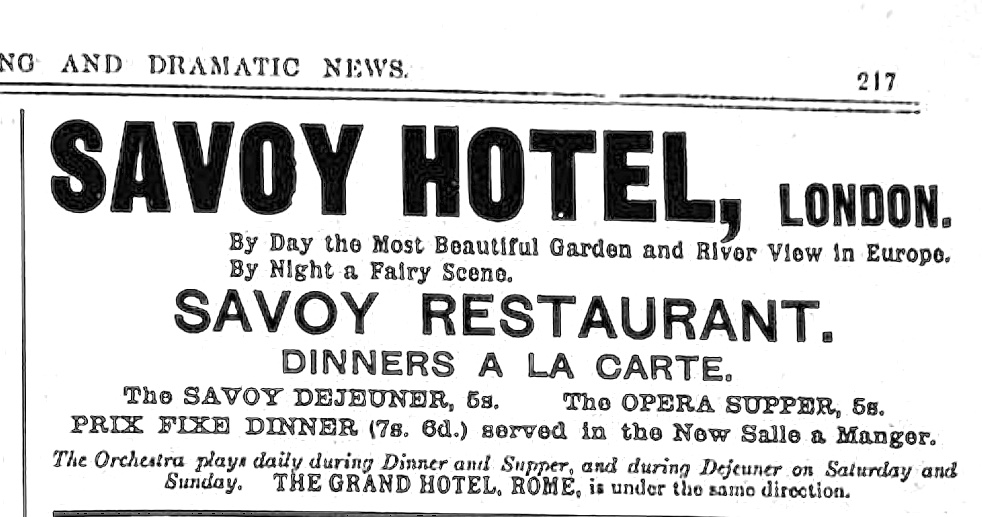
  The dating of Joseph’s departure from the Savoy can be made from the evidence of advertisements of that time, one from 1899 enthusiastically broadcasting that “The Restaurant is under the direction of the famous Maître d’Hôtel “Joseph” of Restaurant Mariveaux Paris. Chef Maître Thoreaux” but the second dating from 6 October 1900 with no mention of the great Celebrity Maître d’ who, one assumes had returned to France by then.


  Joseph was clearly still in London in January 1901 as he was also interviewed by the reporter Horace Wyndham with an article being published which was titled “A Maître d’Hôtel and his Methods”. Wyndham wrote, “...the cook in question happened to be one of the eminence of M. Joseph of the Savoy Hotel. Indeed, the ruler of the roast at this establishment is more than a cook; he is an artist, and a master of his art, to boot”.

  Wyndham was surprised to learn of Joseph’s English origins, though he does not mention that Joseph was born in Birmingham, and concluded that it was therefore not surprising to “find that he speaks English with remarkable facility” The interview revealed that Joseph was still “a child when he was taken by his parents to their native France, and, as soon as he was old enough to be of use, he assisted his father in the management of a restaurant that he had set up near Paris. In 1868, he had blossomed into a fully fledged cook, and as such obtained a situation in a restaurant at Brébant. Here, “though the remuneration was but little ... Joseph remained for five years and “ soon had the whole gamut of the cuisine at his fingers’s ends”. He then moved on and worked at the distinguished Paillard’s restaurant in Paris.


  From what I have discovered so far it seems Joseph died in 1903. 

  While accepting that M Joseph’s links with Birmingham ended at an early stage of his life, we can claim him at least as being a Brummie-born and as such he is one of the greatest names in Birmingham’s gastronomic history. Bon appétit!

The large restaurant of The Savoy, c.1900.