Of course we are all very familiar with Celebrity Chefs. They have been popping up everywhere - particularly on television of course for several decades. I can remember Fannie and Johnny Craddock (we shall not see their like again) and Galloping Gourmet Keith Floyd whose programmes are being rescreened piecemeal on Saturday Kitchen and others.
To hover over Keith Floyd for a second, he really is an immortal as the Saturday Kitchen snippets show. And some of the interviews he conducted during his world-ranging tours are gastronomic history in their own right. Just two or three weeks ago an interview with Jeremiah Tower at his Star restaurant in California was screened - an amazing opportunity to see this major culinary figure talking and preparing a dish from three decades or so ago. Great stuff.
 |
Keith Floyd and Jeremiah
Tower |
 |
| Jeremiah Tower |
 |
| Tower’s Californian cuisine |
Television ‘cookery’ programmes proliferated. Ready Steady Cook brought a range of chefs to the public’s attention including Brian Turner, Gary Rhodes and Anthony Worrall Thompson who represented the Central region in the first ever season of Great British Menu and famously burned his faggots and then Birmingham’s own Glyn Parnell turned up on GBM and got a dish to the banquet for two consecutive years and made appearances irregularly on other programmes subsequently. If Gordon Ramsay was not known by many before he began his television career it was not long before he was a household name.
So that’s celebrity chefs. They go back further than we think. When Auguste Escoffier was working at the Savoy from 1890 to 1898 he too was a household name. The anticipation of Col. Nathaniel Newnham- Davis, early English food critic (of whom more in an upcoming Blog) at the prospect of eating his way through a meal fromEscoffier’s kitchen is fascinating to read about in his article for the Pall Mall Gazette. But Newnham-Davis also draws attention to then famous front-of-house staff as well, which we do far less often in these modern times though bad service can still ruin a happy meal as much as an underseasoned dish.
Of course experienced waiting staff then played a much greater role in the preparation and theatre of a dish than they do now. Now we may chat nicely to and be pleasingly schmoozed by the restaurant manager whom we’ve come to know from our visits to a favourite restaurant but apart from presenting the dish and taking away the empty plate at the end of the course they may do nothing more than pour some of the sauce on to our meal or do something with liquid carbon dioxide or fiddle around folding up our napkin if we have cause to leave the table. Perhaps that is why, as key players on the stage of the restaurant’s theatre, front of house staff, as we may now call them, had their own celebrities as exalted as some of the chefs.
And now we come to the point of this piece and the relevance to the subject of Birmingham Food. I have been intrigued by a character identified by Newnham-Davis as M. Joseph whom N-D reveals to have been born in Birmingham, presumably in the mid-19th century, of French parents. After Escoffier was sacked by The Savoy in 1898 in a fraud scandal (he confessed to taking kickbacks from food suppliers) along with César Ritz and the Maître d’hôtel, Louis Echenard, Monsieur Joseph was brought in by the Savoy’s owner, Richard D’Oyley Carte, to take over as Mâitre d’hôtel. Joseph had previously been employed as the Maître d’hôtel at the Marivaux restaurant in Paris and in Newnham-Davis’ and Algernon Bastard’s book, The Gourmet’s Guide To Europe (published 1903), Joseph who had died by then, was described as having “brought the Marivaux to such a high pitch of fame before he emigrated to London” and was identified as having worked prior to the Marivaux (which still survives serving Savoyard cuisine) at Paillard’s (described in 1903 as then being “type and parent of the present up-to-date restaurant”). Joseph - let us call him, hopefully not disrespectfully, purely for the pleasure of identifying him with our city and making him relevant to this blog and claiming our little piece of attachment to this great fin de siècle gastronomic figure - Joseph The Brummie - took up the reins at The Savoy from Echenard pretty smartishly and was obviously well-established there, no doubt his reputation travelling with him from Paris, by the time N-D interviewed him apparently in 1899.

So we have a Birmingham-born, albeit of French parentage (or so he claimed) super-star Maitre d’hotel, being head-hunted by D’Oyley Carte to take charge at The Savoy at short notice and arriving in London with a remarkable amount of recognition among those who knew about food and service in fine restaurants. Newnham-Davis was clearly very admiring and went to the trouble of organising a special interview with this accomplished Brummie during the course of which he was able to discover that Joseph was an “adept at la savate” (French boxing) and had a single “amusement” in his life which was “pigeon flying”.
N-D described him as being, “A little man, with rather long hair, bald on the top of his head with very dark brown eyes looking keenly out from strong brows, with a little grey moustache”. He added that “Joseph arrests attention at once, and his manner is just the right manner. In a short black coat, white waistcoat, and dark trousers ....”. I have not yet been able to track down a photograph of Joseph The Brummie but fortunately N-D’s book, The Gourmet’s Guide To London (published 1914) includes a cartoon titled Joseph carving a duck from a drawing by Paul Renouard which gives us a fine impression of the physical appearance of M. Joseph. I wonder how many of our present-day Maitre d’s might carry off carving a duck or preparing a crepe at the table today with the panâche of Joseph The Brummie. It would certainly bring back the theatre of dining out and be a worthy substitute for the whispered detailed dish descriptions which leave us none the wiser to which we are frequently subjected by front-of-house staff at this present time.
M. Joseph brought with him to The Savoy, the chef from The Marivaux, M. Thoreaux, as well, according to Newnham-Davis, “his system of management” by which he “liked to take a personal interest in each dinner that was progressing in his restaurant and to give it his personal supervision”. N-D however felt that the Savoy restaurant was too large for Joseph’s preferred method of service. He certainly strove for perfection, N-D remarking that Joseph was “wrapped up in his profession” and that “he looked at his boots the whole time that he took his afternoon constitutional walk, that he might think of new dishes. Whenever any novel idea occurred to him he tried it at home in his own little kitchen before asking M. Thoreau to make experiment on a larger scale. To see Joseph carve a duck was a very splendid exhibition of ornate swordsmanship, and his preparation of a canard à la presse was quite sacrificial in its solemnity. There was in his day a dinner given at The Savoy at which Madame Sarah Bernhardt was the chief guest, and most of the other people present were “stars” of our British stage. Joseph cooked before them at a side table most of the dishes of the dinner, and told me that he did so because he wished to show actors and actresses, who constantly appeal to the imagination of their audiences, that there was something also in his art to please the eye and stimulate the imagination”.
When asked by N-D why he never went to the theatre, Joseph replied that he would “sooner see six gourmets eating a well-cooked meal than watch the finest performance that Madame Bernhardt and Coquelin could give”. Well, I’m sure there’s drama enough in observing six gourmets comfortably installed around a well-served dinner.
N-D wrote that Joseph “had a pretty wit and a facile pen. This was the jeu d’esprit that he once wrote in a young lady’s album - “C’ėtait la prèmiere côtelette que coûta le plus cher à l’homme - Dieu en ayant fait une femme”. N-D was delighted to report that, “And he wrote for me a little essay on the duties of a maître d’hôtel that was very sprightly in style. He was even a greater believer than M. Ritz in the short dinner, and declared that we in England only tasted our dinners and did not eat them. Three dishes he considered quite enough for a good dinner [good Brummie common-sense I say to that one] and this was a tiny feast he ordered for me on one occasion when I took a lady to dine at The Savoy:-
Petite marmite
Sole Reichenberg
Caneton à la presse Salade de saison
Fonds d’artichauts à la Reine
Bombe pralinée. Petits Fours
Panier fleuri.
The panier fleuri he carved himself at table for me.”
Newnham-Davis wrote, regret and sadness evident in the simplicity of the sentence, “Joseph became homesick, for he was a thorough Parisian, and went back to the Marivaux, but soon after he died.
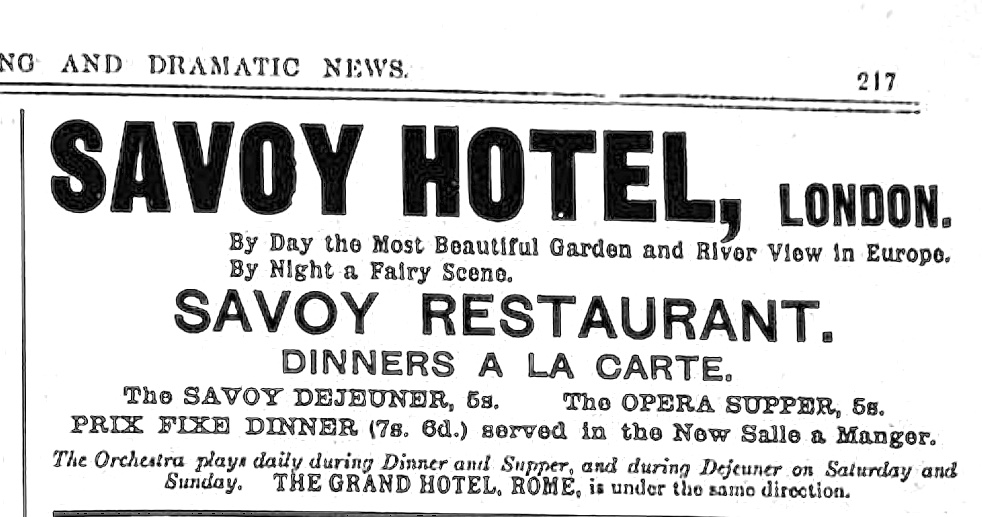
The dating of Joseph’s departure from the Savoy can be made from the evidence of advertisements of that time, one from 1899 enthusiastically broadcasting that “The Restaurant is under the direction of the famous Maître d’Hôtel “Joseph” of Restaurant Mariveaux Paris. Chef Maître Thoreaux” but the second dating from 6 October 1900 with no mention of the great Celebrity Maître d’ who, one assumes had returned to France by then.
Joseph was clearly still in London in January 1901 as he was also interviewed by the reporter Horace Wyndham with an article being published which was titled “A Maître d’Hôtel and his Methods”. Wyndham wrote, “...the cook in question happened to be one of the eminence of M. Joseph of the Savoy Hotel. Indeed, the ruler of the roast at this establishment is more than a cook; he is an artist, and a master of his art, to boot”.
Wyndham was surprised to learn of Joseph’s English origins, though he does not mention that Joseph was born in Birmingham, and concluded that it was therefore not surprising to “find that he speaks English with remarkable facility” The interview revealed that Joseph was still “a child when he was taken by his parents to their native France, and, as soon as he was old enough to be of use, he assisted his father in the management of a restaurant that he had set up near Paris. In 1868, he had blossomed into a fully fledged cook, and as such obtained a situation in a restaurant at Brébant. Here, “though the remuneration was but little ... Joseph remained for five years and “ soon had the whole gamut of the cuisine at his fingers’s ends”. He then moved on and worked at the distinguished Paillard’s restaurant in Paris.
From what I have discovered so far it seems Joseph died in 1903.
While accepting that M Joseph’s links with Birmingham ended at an early stage of his life, we can claim him at least as being a Brummie-born and as such he is one of the greatest names in Birmingham’s gastronomic history. Bon appétit!
 |
| The large restaurant of The Savoy, c.1900. |