Showing posts with label Marco Pierre White. Show all posts

Sunday, 18 July 2021

166. In Stratford Another Sad Farewell - To The Scullery.


  And this is how it happened. Lucy The Labrador and I were back in Stratford and I wanted to have another happy evening enjoying Chef Andrew Edwards’ wonderful food (see Blog 80) which he has been serving since 2014 in his charming little restaurant in Greenhill Street, No 33 The Scullery. I took a quick look at Tripadviser to see what the latest vox populi had to say about this darling little place only to discover that it had completely disappeared from the listings. Alarmed, I scurried through the internet trying to find out what was happening and discovered that it had been rebranded, and it seemed reasonable to me to tie it more to Shakespeare, as Prospero. I thought that was a clever move by Mr Edwards, putting the days of the lockdown behind the restaurant, except that a well established brand had disappeared which could hurt trade and, as I was to discover, the rebranding had not been carried out by Andrew Edwards.


  There was a bit of a do trying to get a reservation - one day none were available, the following day, thinking I would just check, there was no problem securing a reservation at my preferred time. 

 On the arranged day I arrived at 7PM expecting the restaurant to be quite busy but in actuality only one other table was taken. I received a pleasant greeting from a charming lady I recalled from a previous visit and was seated at a table of my choice noting as I did that though the restaurant had been rebranded the decor at least was unchanged what with its Jack Vettriano prints and quotes about dining and food.


  I was asked if I wished to order a drink. I asked for a Cotswold Gin and tonic but was told that the restaurant only sold Gordon’s plus one or two of its flavoured gins. I assumed it was reasonable to limit the options when a period of financial upheaval has taken place and pragmatically chose rhubarb and ginger flavoured Gordon’s which was pretty unpleasant. The menu had been drastically pared back as well. The ‘Specials’ blackboard had disappeared and there were only 4 choices for each course on the menu, though one of the starters and one of the main courses were not available, a state of affairs for which the very nice front of house lady apologised. But I was glad was that some of The Scullery’s great dishes did still feature on the list of dishes. And I went for their previously excellent scallop starter and the stone bass main course which had previously been quite fabulous there.


  The scallops, very well priced, were a great pleasure, perfectly cooked and with a joyous sweetness that I had not experienced in other more expensive restaurants recently. The presentation was a little odd with the scallops themselves looking very pretty with again perfectly prepared samphire a delicious liquor sitting in a shell but the shell itself balanced somewhat inelegantly on a plate with an apt but lonely-looking rasher of bacon and three peaks of inapt mashed sweet potato. The shells themselves would have been much the preferable with perhaps little cubes of bacon or pancetta added to the scallops in them.


  The stone bass main course, cooked extremely well and so delightfully simply, served attractively with mussels and summer vegetables, was delicious and was not far from being as good as the first stone bass I had at The Scullery some years ago and which was so exquisite that it remains a happy memory with me. A dish to give great pleasure and again very reasonably priced. 
  I was curious to know about the rebranding and I discovered that Andrew Edwards had sold the restaurant - I was sad to hear it - and a new unidentified chef had prepared the meal. I suspect the new chef had worked there before as the dishes could all be described if works of art as “After Edwards”. The new chef had obviously been an attentive pupil. More alarming was the revelation that the new owner had also taken over other local businesses - a pub was named which in my perusal of Tripadviser had recently attracted a lot of adverse comments - and the alarm bells began to ring that this sweet little local restaurant had fallen into the hands of a profit-first merchant, hence the reduced menus and drinks options. Stratford has far too many so-so bistros in Sheep Street all owned by the same proprietor without the loss of The Scullery. We will see what develops. Meanwhile it has to be noted that though there were few diners food was very slow coming out of the kitchen. Perhaps the new chef is finding his or her feet given that the Prospero opened only last week.

  I chose one of the three desserts on offer - a vast and not attractively presented Eton Mess. To be fair I enjoyed the ice cream element for sure but it seemed that a single finely chopped-up strawberry had found its way into the dish. This was an interesting if inaccurate twist on the term ‘Fine dining’.


  I departed Prospero having broadly enjoyed my meal but feeling wistful and anxious. I hope this pleasing little restaurant can maintain the standards and principles established by Andrew Edwards when he first opened it. The food there has given much pleasure over the years. And so I say to No 33 The Scullery, “Now cracks a noble heart - Good night sweet Prince. May flights of angels sing thee to thy rest”.

Andrew Edwards of No 33 The Scullery.


 Meanwhile there is some optimism to be felt in Stratford - I hear that the Mercure Shakespeare Hotel, previously home to a mediocre Marco Pierre White New York-style restaurant which in an unseemly fashion replaced Shakespeare with White, is unlikely to be replaced by another branded chain restaurant but instead will have its own in-house restaurant and, fingers crossed, possibly a good one. The Falcon has The Woodsman, and look how successful that is, so there may be hope of something good materialising at the historic Shakespeare.


Thursday, 27 May 2021

153. Stratford Resurgens But No. 9 Closes.


  Lucy The Labrador and I were back in town and reinstalled after half a year’s absence at the Shakespeare Hotel in Chapel Street which over the years has become one of our second homes - old, atmospheric, friendly, comfortable, historic (like we two). The pandemic had taken its toll, many members of the previous staff whom we liked very much had moved on and there was still an air of palpable dismay about the place.

  One of the worst things about the hotel had been its restaurant - a Marco Pierre White New York-style concept which never looked happy in the surroundings of hoary panelling and low ceiling beams and honoured White more than it ever did Shakespeare. The food was edible but far too expensive for what it was and large photographs of White were scattered all around which was not to any degree tasteful. It never seemed right to be eating Italian-American cuisine in a place as English as the Shakespeare. What the hotel needed was a good modern English restaurant and - now that the pandemic has led to the Marco Pierre White restaurant closing which saddens because of the lovely staff who worked there but otherwise brings me relief knowing that the hotel could receive a great boost if the right sort of establishment takes over - that opportunity has arrived. There was a certain satisfaction to be experienced to see the photographs of White having been removed in the restaurant and in their place a bust of William Shakespeare restored to his rightful place, God bless him.

  But dinner must be had and so, off across the road to the Indigo Hotel where the Michelin Plated restaurant, The Woodsman is located.


  I have written reports about this excellent restaurant before and I was impatient to return there to see what was on offer to make my digestive juices flow. Here are the choices available for the starter and main courses:-


   I could not miss the opportunity of ordering the combination of seasonal English asparagus and Dorset crab as starter and after a little consideration opted for Berkshire pork chop as the main course. Unfortunately another starter was served to me which was a disappointment but I found it easier to have the unordered dish than to send it back as it looked interesting and proved to be very tasty - it was the Globe artichoke velouté with cuttlefish ragu and hazelnuts. To me this was highly innovative, I loved the texture of the nuts and the velouté itself, an attractive green, was pleasurable with the whole dish being visually impressive.


  On to the vast pork chop served with fennel choucroute, roast apricots and black pudding. The accompaniments matched the beautifully cooked chop very well and this made for a magnificent dish. The pork was tasty and tender as it could be and the apricot was pleasing but, for me at least, nothing really beats the humble apple as a sweet-acid companion with grilled or roast pork, call me old-fashioned if you will.


  The desserts were tempting but the chop had been so generously sized that I knew that it would be unwise to proceed further. This was a grand meal and a fine setting. I would be happy to visit The Woodsman whenever I may.

  The following fine spring evening, I set off to walk the 200 yards from The Shakespeare to Paul Foster’s Michelin-starred Salt and as I approached the restaurant I was shocked to find that its Michelin-listed next door neighbour No 9 Church Street, one of the most notable dining places in Stratford, had been closed permanently. Chef Patron Wayne Thomson who had run and cooked at No. 9 since 2010 left messages on a number of social media sites on 12 May 2021 announcing the charming little restaurant’s departure from the scene. For those who have enjoyed eating there over the years we can only feel that Parting is such sweet sorrow .... It appears that a Thai restaurant will open in the building “soon”.


  And so to dinner at Salt. The internal decor is unchanged and did not need to be. What had changed from my last visit three or four years ago was the welcome. I was greeted by an excellent waiter and the new Maître d’Hôtel and instantly felt pleased to be at Salt. I was a little disappointed to have only one choice of menu available to me - the £85 eight course Tasting menu (I should have read the information on the restaurant’s internet site and I would have known) - sometimes less is more particularly for an old bloke whose stomach tends to protest if he places too much food in it in too short a time space. But the menu was intriguing and so the evening got underway with olives and toasted almonds and tasty bread and butter.


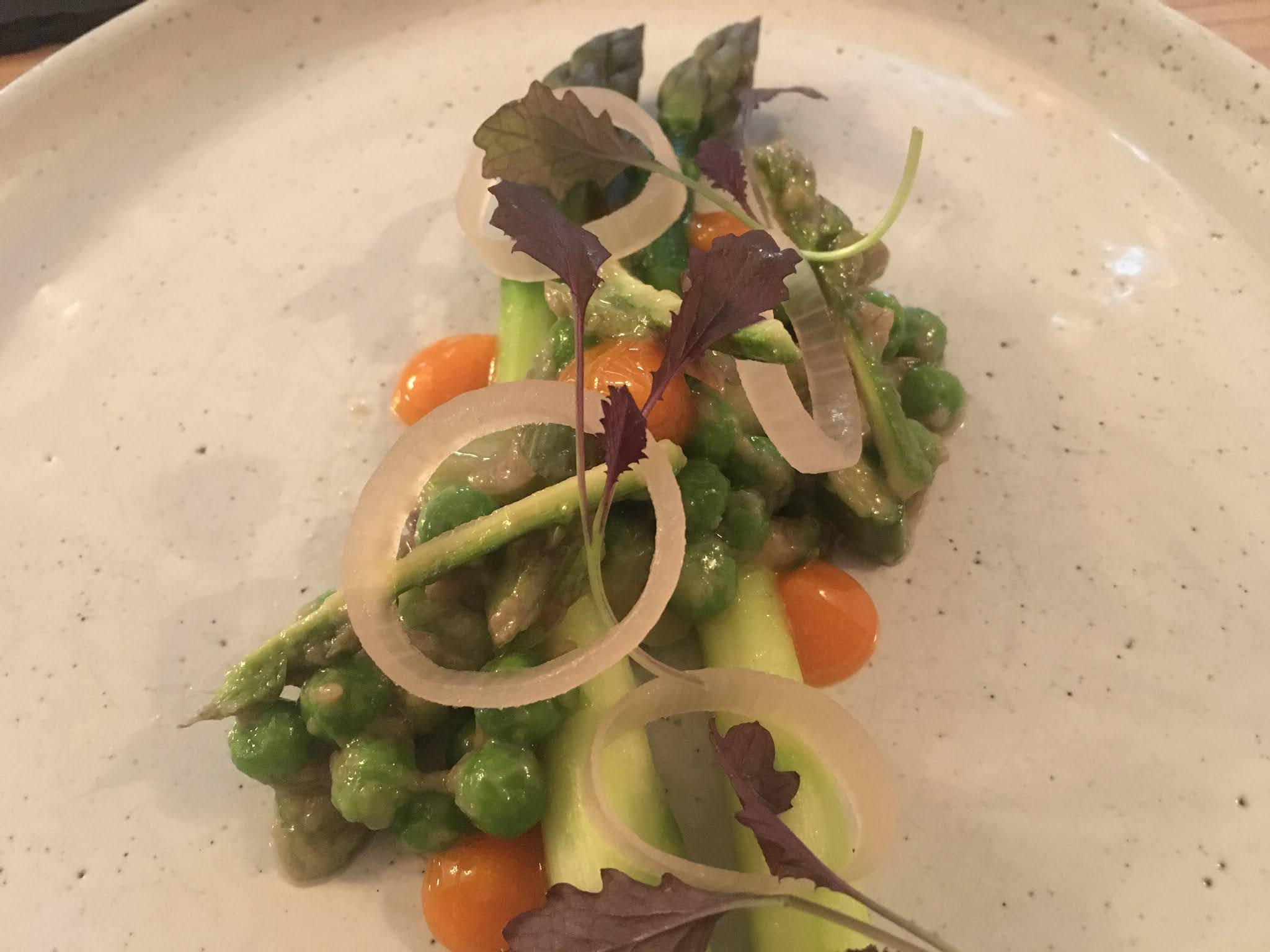
  At last, seasonal English asparagus cooked perfectly served with little blobs of egg yolk, nicely cooked peas and asparagus salad.  An excellent start.


  And then a real gem, a fabulously delicious celebration of scallop. Slices of scallop, one optimally fried in butter, the other two served ceviche with the most wondrously flavoured sweet and sour dill purée, little pieces of grape, thin slices of cucumber and the necessary texture provided by crumble of rye cracker. A truly great dish.


  Then an altogether different kettle of fish - carrot cooked in chicken fat, crispy chicken skin (I could not identify any on my plate) and pickled carrot. There really seemed no point in having this dish on the menu. This was not a vegetarian menu so what is the point of a few bits of carrot in a bowl and not much else? This reminded me of a large dish of brassicas unaccompanied by anything else served to me at Joro in Sheffield some time ago or being served a starter of nothing more than a large mound of mashed potato once at Carter’s of Moseley - there really was no pleasure in it, eating it was a matter of just going through the motions. In a large non-vegetarian menu there really is no place for this eccentric voyage into isolated vegetable eating - Chefs please note - vegetables are best served as accompaniments of  protein. I did not finish the course nor did I photograph it. On to a dish of mushrooms - roasted hen of the woods, shimeji, goats curd and smoked bone marrow sauce. This was a very tasty dish as you might expect from the list of ingredients.


  On to an original and tasty dish full of clever flavours - a Coronation chicken with the poultry substituted by lamb sweetbreads. Contrary to the sentiments of many modern food lovers, having been brought up in the era after rationing ended when people wanted to eat real meat having been forced by first the War and then Attlee’s government to eat all sorts of innards of other species which they would not necessarily have chosen to do, I do not seek out sweetbreads. However here some were prepared to a fine standard which made the texture bearable and more importantly rendered very tasty by the sublime upmarket version of Coronation sauce with its pretty little golden sultanas and the gentle surf of curry washing on to its shores.


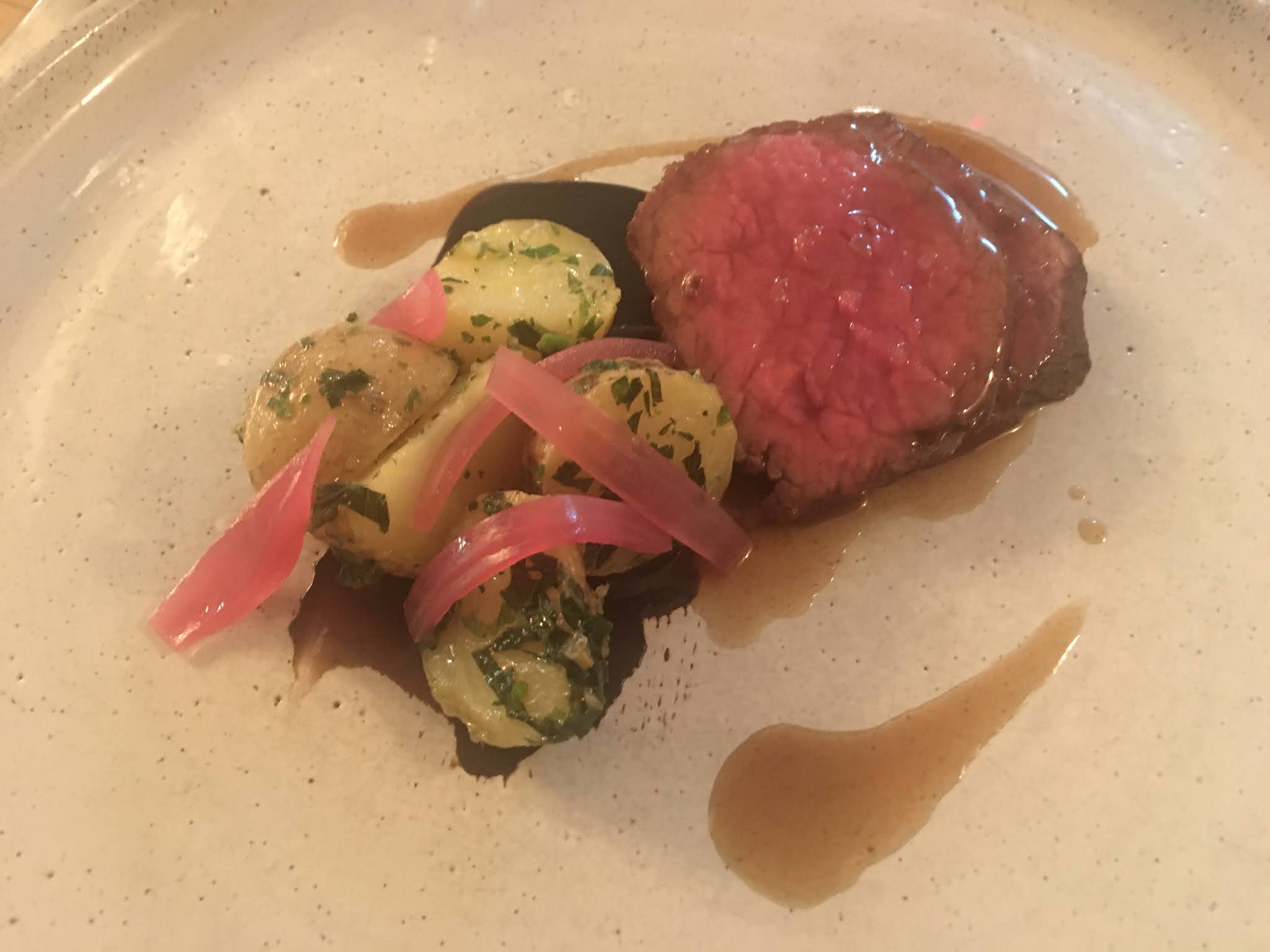
  And to the centrepiece - immaculately cooked and seasoned sirloin (how lovely it is to go back to restaurants now and find that a dish of beef is not a daube or an ox cheek but high quality cuts of meat - has the pandemic brought chefs to their senses wherein they realise that diners enjoy high quality cuts particularly if they are paying a lot of money for it? - the 2020s, it seems, may offer hope of a fine new direction for chefs and diners). With it, what joy, shockingly enjoyable minted new potatoes, totally apt pickled onion slices and a memorable, unctuous black garlic sauce. This dish identifies just why the Michelin inspectors handed Salt one of its macarons.


  The darling pinkness of the beef was matched by that of the exquisite, dainty strawberry and thyme tartlet, the pastry of which was as fine as one could hope for and its contents a fairyland of pure pleasure. And it came with a devastatingly inspired ice cream, lovage-flavoured, which could not have been improved on as a match for the dish. A high was reached and I was full of delights. I had to send my apologies to Chef Laura Kimber and her excellent assistant for not being able to move on to the final dessert course - “Chocolate, miso, tonka bean and peanut toffee”, which leaves the reader with watering mouth and needing to imagine how pleasurable it would have probably been but I was too full and that was the end of it. A five course meal would have sufficed and I would certainly have felt no less fortunate for having missed the carrot course but that was the menu and I have described it as I ate it with all its glories and one or two weaker points. 


  Back to The Shakespeare. There the expensive and poor Marco Pierre White restaurant has, like the dinosaurs, achieved extinction. Missed by few. A little way along the road No 9 Church Street has passed into West Midlands gastronomic history. Genuinely mourned. But Stratford seems resurgent. The Woodsman and Salt are there. Now if only The Shakespeare Hotel could set its heart (being in the town’s very heart) on giving space to an apt and relevant restaurant of quality and make its contribution to Stratford Resurgens.

Farewell, for now, Chef Wayne Thomson


Wednesday, 17 March 2021

134. The Restaurant, Boiled Curate’s Egg.


  I have obtained in the past few days - and almost finished reading - William Sitwell’s book published in 2020 titled The Restaurant A History of Eating Out. I am not sure why I have not read it before but I suppose it’s rather like going to a restaurant and wondering why you have not dined there already.

  I am presently grappling with trying to understand the history of dining out to more appreciate what and why I’m eating when I sit in one of our Birmingham or West Midlands restaurants. The history of British eateries is very interesting - over time our providers of hospitality have both given to the world and taken from it.

  Sitwell’s book is more a provider of anecdotes, often very tangential to the subject - sometimes relevant and fascinating, sometimes irrelevant and interesting and sometimes, alas, irrelevant and dull. Of course his subject is the the history of the restaurant (anywhere in the world) and not the history of the restaurant in Britain and how we dine now here in Birmingham lends much to what has happened elsewhere - The United States, France inevitably, Spain, Italy, India and more recently Scandinavia so it is not unreasonable to spend a minute or so musing about the dining scene in Pompei as Vesuvius began to erupt or the free food provided by the Ottoman Emperor to the ordinary people around his palace grounds. But there is far too much of it. The story suddenly wanders down alleys of irrelevance describing the manner in which Robespierre was guillotined for instance (there seems to be an obsession with beheading as in another chapter Sitwell describes how a slave decapitated himself in front of the Arab traveller Ibn Batuta) and dropping in snide comments about British politicians he clearly doesn’t like especially those who offended his Remoaner sentiments. 

  It’s a shame because generally, and clearly it isn’t intended that the book be a piece of academic excellence, the story proceeds along merrily enough dabbling in the developments this Old Bloke has lived through which have lead us from Attlee’s Age of Austerity (which socialists seem to have forgotten about) when food, if you could get it, was something you put in your mouth and eventually digested but could hardly ever be thrilled about (though as a boy my tastes were undemanding), through the coming of the restaurant increasingly available to all, the silliness of nouvelle cuisine, the horrors of molecular gastronomy and the age of foraging to the year of home delivered high quality meals.

  It’s an easy read except when Sitwell strays too far from what he needs to tell us. There’s much to glean from it and it’s a rather nice book to have, the cover is so nice in fact that the publisher has not splashed out on a dust jacket which seems justified given the book’s stylish white, grey and black look. A quote on the cover by Marco Pierre White who must have been happy with the references to him in the book includes the phrase, “(Sitwell) ... holds the pen of PG Woodhouse” which for all I know may have been meant literally, though I doubt it, but as a literary allusion makes me think that Mr White has probably not actually read any Woodhouse.

 The book is good but disappears up side alleys far too often and for too many pages, so it is good in parts. The book editor should have reined in some of Sitwell’s more elaborate digressions and made the book shorter or even to have allowed for an additional chapter on the development of restaurants in the large part of Britain which is not located within the boundaries of London or the Home Counties. But perhaps Sitwell is on less certain ground when it comes to talking about what’s happening outside of those geographical limits.